 SUBSCRIBE



Interior landscaping is a niche service category that once attracted some of the largest firms in the landscape industry, luminaries such as TruGreen and ValleyCrest (now part of BrightView). In the 1990s and 2000s, these companies built interior plant divisions and later scaled them back or sold them off, including the 2000 sale of TruGreen Interior Plantcare to what is now Ambius.
Now, two decades later, new interest is emerging in the landscape industry, highlighted by Yellowstone Landscape’s 2024 partnership with interiorscape firm Greenery NYC.
Research on global plant care and interiorscaping services suggests a market in the mid-single-digit billions — around $3.5 billion in 2024 — with high single-digit annual growth, implying the market could roughly double over the next decade. Growth is fueled by a mix of global and national providers, including Ambius and Planterra, and a large base of local interiorscape firms such as Greenery NYC.
Even with these growth projections, interiorscaping remains modest in scale compared to the roughly $180-190-billion U.S. exterior landscaping industry.
Prime time players
Shane Pliska, CEO of Planterra, leads the second generation of the Detroit-based family business that has grown into one of the largest interiorscape service networks in North America.

Building on the company his parents founded, Pliska expanded Planterra from a regional interiorscape firm into a national provider by combining centralized account management with local delivery through the Planterra Network, a partnership with owner-operated interiorscape firms. Planterra subcontracts service delivery to these local partners, who provide on-site expertise and long-term plant care for national clients.
“Specialization has allowed us to punch above our weight,” Pliska says. “Local owner-operators truly know each site and each client. That knowledge drives consistency and performance, always outperforming a corporate employee.”
Planterra competes for national interiorscape contracts with Ambius, a division of U.K.-based business services group Rentokil Initial. Rentokil built what is now Ambius through an international acquisition strategy spanning two decades from the 1980s to the 2000s, including the purchase of TruGreen’s Interior Plantcare division in 2000. Today, Ambius operates in roughly 16 countries.
In 2021, Ambius generated £141.3 million in ongoing revenue (roughly $190 million). Since 2022, Ambius has been reported as part of Rentokil Initial’s broader “Hygiene & Wellbeing” category — alongside dental hygiene and cleanroom services — rather than as a standalone reporting segment, and pre-pandemic figures indicate modest, low single-digit annual growth in Ambius revenue over several years.
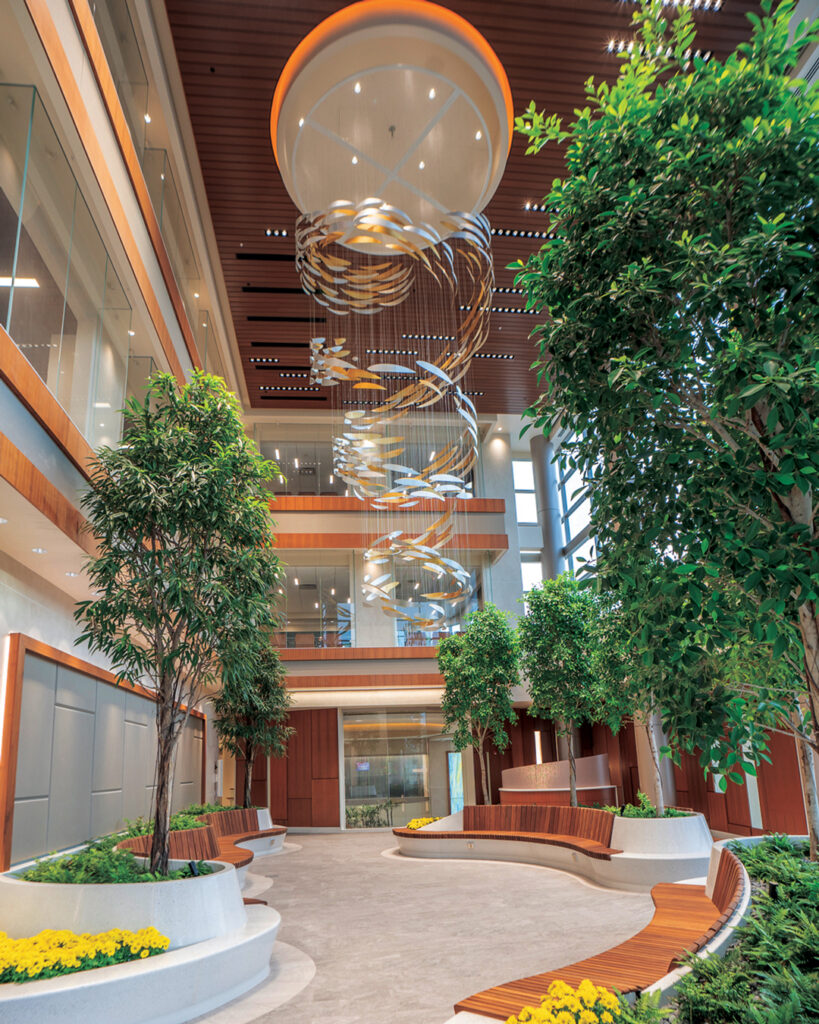
Interest in interiorscaping is increasing as biophilic design gains mainstream traction and workplace wellness becomes a core part of corporate strategy. Companies are turning to interior landscaping to meet these new demands.
The role of interior landscaping
The modern interiorscape industry took off in the 1970s and 1980s during the rise of large indoor malls and corporate office buildings. Once treated as purely decorative, interior plants gained new importance after the pandemic as organizations looked for ways to support employee wellness and create healthier indoor environments.

“There’s a deeper understanding of wellness benefits of the human-nature connection and a desire to see nature thrive over time, not just die a slow death in a dark conference room,” says Rebecca Bullene, founder of Greenery NYC.
Bullene says Greenery NYC has seen increased attention from national firms looking to expand into interiorscaping and from clients who now view plant programs as part of their broader workplace strategy. Pliska also hears from private equity groups exploring the category but notes that traditional scale models rarely fit interiorscaping.
“They are attracted to the biophilic buzz and the corporate client names,” he says. “Once they understand the true size of the market and the limited number of midsize operators, the scale proposition shifts.”
Pliska takes pride in creating national contract opportunities for local interiorscapers through the Planterra Network and has no plans to sell the business.
Getting involved
For exterior landscape companies, interiorscaping can appear to be a natural extension of existing offerings. Pliska cautions that the operational model differs significantly.
“There was a time when it was assumed that a landscape company could do interior work in the winter if there wasn’t much snow plowing. The difference is that interior landscaping is a year-round service. And the type of labor that goes on inside a building is different. So, it requires having two types of staff, along with different training, suppliers and equipment,” says Pliska.
Interiorscape contracts also tend to be smaller than exterior landscape contracts, even though the effort to win and retain accounts is similar. Volume and operational discipline are essential for long-term success. Yellowstone Landscape reinforces this point through its partnership with Greenery NYC, which operates as a distinct brand.
“We’re able to scale our biophilic design vision beyond New York. And for Yellowstone, it expands their portfolio into interiorscaping, giving them a competitive edge in offering holistic green solutions,” Bullene says.
She adds that collaboration has created opportunities for shared learning. “Working with leaders in the exterior landscape industry has helped us improve operationally and create more training and growth opportunities for our team.”
As interiorscaping evolves, industry leaders will likely be those who combine national reach with local expertise and who understand the intersection of design, wellness and long-term plant care. Planterra and Greenery NYC represent two distinct growth paths in a category that is rebuilding momentum after many years of quiet stability.