 SUBSCRIBE


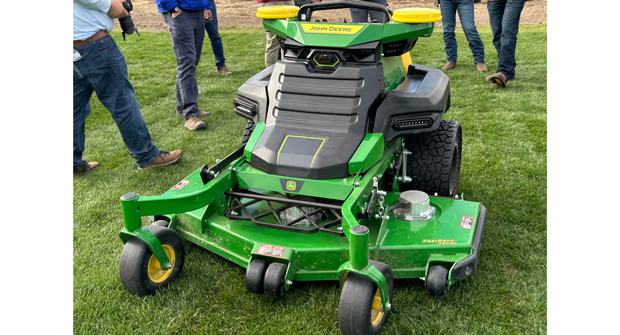
At the 2025 CES — America’s largest trade show and among the world’s most discussed technology events — the Apples, Googles and Metas of the tech world found themselves sharing the spotlight with a name normally associated with farm fields, golf courses and home lawns: John Deere.
The company made a splash at that show as it unveiled autonomous offerings on equipment serving the agriculture, construction and orchard industries. Even commercial landscaping got a shoutout, as Deere showed off a prototype of an autonomous commercial stand-on mower, one that had first been revealed to industry media during a press preview event in November 2024.
The debut of a working mower prototype raised hopes in the industry that a commercially available autonomous unit from John Deere was right around the corner, one that would join the growing number of robotic cutting units available to landscape contractors and lawn care operators.
Alas, that hasn’t happened yet. John Deere did display a next-generation version of the prototype mower during Elevate 2025 in Phoenix, and the company continues to pursue extensive field work on the unit. But as far as when landscape pros can actually begin adding an autonomous Deere mower to their fleets, that remains TBD.
To get an update on this autonomous mower and Deere’s progress in bringing robotic technology into commercial landscaping, Landscape Management sat down for a Q&A with Justin VanderHeyden, Deere’s product manager for commercial landscaping autonomous mowing. We checked in on the status of this stand-on mower, how the company uses advances in other industries it serves to inform improvements in landscaping and talk about the work that still needs to be completed before contractors can expect to see a John Deere autonomous mower at a dealer or distributor near them.
Q: How does the autonomous stand-on mower that was on display at Elevate 2025 differ from the unit that was featured during the pre-CES media event in late 2024?
A: The autonomous stand-on mower shown at Elevate 2025 reflects the evolution of the program since the pre-CES media event in late 2024. While the earlier unit was intended to help illustrate our long-term vision for autonomy and spark early conversation, the Elevate machine represented a more refined development platform informed by additional field learning and contractor feedback.
Between those two points, our focus has been on improving how the system performs in real-world commercial environments — accounting for property variability, safety considerations and how autonomy fits alongside existing crews and workflows. The Elevate unit incorporated updates intended to support more realistic demonstrations and discussions with professional landscape contractors rather than serving as a conceptual showcase.
Overall, the differences reflect steady progress in the program and a shift from vision setting to practical learning.
Each iteration is designed to help us better understand where autonomy delivers value for landscape contractors and what it will take to make the technology reliable, predictable and scalable in commercial landscape operations.
Q: What does the path to commercial availability look like for this unit?
A: The path to commercial availability is focused on deliberate, real-world validation. In 2026, the emphasis is on field learning, landscape contractor feedback and ensuring the system operates safely and reliably in commercial environments. From there, the work shifts to refining how autonomy fits into existing crews and workflows, with the goal of delivering a solution that provides dependable, practical value before moving toward full commercialization.
Q: How much has work on this unit been informed by lessons learned from John Deere’s other business units — ag, construction, aggregates, etc. — as it relates to autonomy?
A: Our autonomous mower program has benefited significantly from the broader autonomy work underway across Deere. While each program is focused on different use cases and operating environments, they share common challenges around safety, reliability, perception and how autonomous machines interact with people and real-world jobsites.
Lessons learned from other autonomy efforts help inform our overall approach, particularly in areas like system validation, software development and understanding how autonomous solutions need to behave to earn customer trust. Just as importantly, those programs reinforce the value of extensive field learning and iterative development before moving toward full commercialization.
That said, the autonomous stand-on mower is being developed specifically for commercial landscape operations, and its design decisions are driven first and foremost by the needs of professional landscape contractors. The broader autonomy portfolio provides valuable perspective, but this unit’s evolution is grounded in the realities of commercial mowing applications, crew workflows and the environments landscape professionals manage every day.
Q: Are there any unique challenges in developing an autonomous product for the professional turf markets that have been top of mind during work on this stand-on mower?
A: One of the most significant challenges in the professional landscaping environment is operating reliably in complex, GPS-denied or GPS-challenged areas. Many commercial mowing jobs involve working close to buildings, under tree canopies and around other structures where satellite signals can be inconsistent or unavailable. Ensuring the machine understands where it is and how to operate safely in those conditions has been a major focus.
Beyond localization, professional turf sites are dynamic. Crews, pedestrians, vehicles and changing site conditions all introduce variability that an autonomous system must handle predictably. Developing autonomy for this market requires a deep understanding of how contractors work, how properties evolve throughout the year and how equipment must perform alongside crews, not in isolation.
Taken together, these challenges are shaping a deliberate, learning-driven development approach. The goal is not just to make autonomy work in ideal conditions, but to ensure it performs reliably in the real-world environments that professional landscape contractors manage every day.
Q: With a growing number of autonomous options now commercially available to landscape contractors, are you satisfied with where John Deere is in regard to its progress in this segment?
A: We’re confident in the progress we’re making, particularly given the complexity of the professional landscaping environment and the expectations contractors have for safety, reliability, productivity and support. While there are autonomous solutions available today, our focus has been on developing autonomy that performs consistently in real-world commercial conditions and integrates naturally into professional operations.
From our perspective, success in this segment isn’t defined by being first — it’s defined by delivering technology contractors can trust day in and day out. That means taking the time to validate performance across a wide range of commercial sites, addressing challenges like GPS-denied environments and ensuring the system behaves predictably around crews, pedestrians and obstacles on the property.
We see autonomy as a long-term capability, not a one-time product launch. Our progress reflects a deliberate approach grounded in field learning, customer feedback and lessons from Deere’s broader autonomy work. While the market continues to evolve, we’re focused on building solutions that meet the standards professional landscape contractors expect from John Deere equipment when they’re ready to put it to work.