 SUBSCRIBE


In the Dallas-Fort Worth marketplace, a popular landscape design element involves constructing outdoor benches using 2-foot-by-2-foot-by-4-foot limestone slabs.
“They weigh tons,” says Christopher Ramirez with a bit of hyperbole. He is the landscape production manager at Complete Landsculpture, a commercial and residential landscape design-build firm with offices in Dallas, Oklahoma City and Tulsa, Okla.
To manipulate manually, Ramirez says these hefty 1-ton design elements demand multiple crew members risking their safety if each block is not maneuvered carefully and correctly around a commercial or residential jobsite.
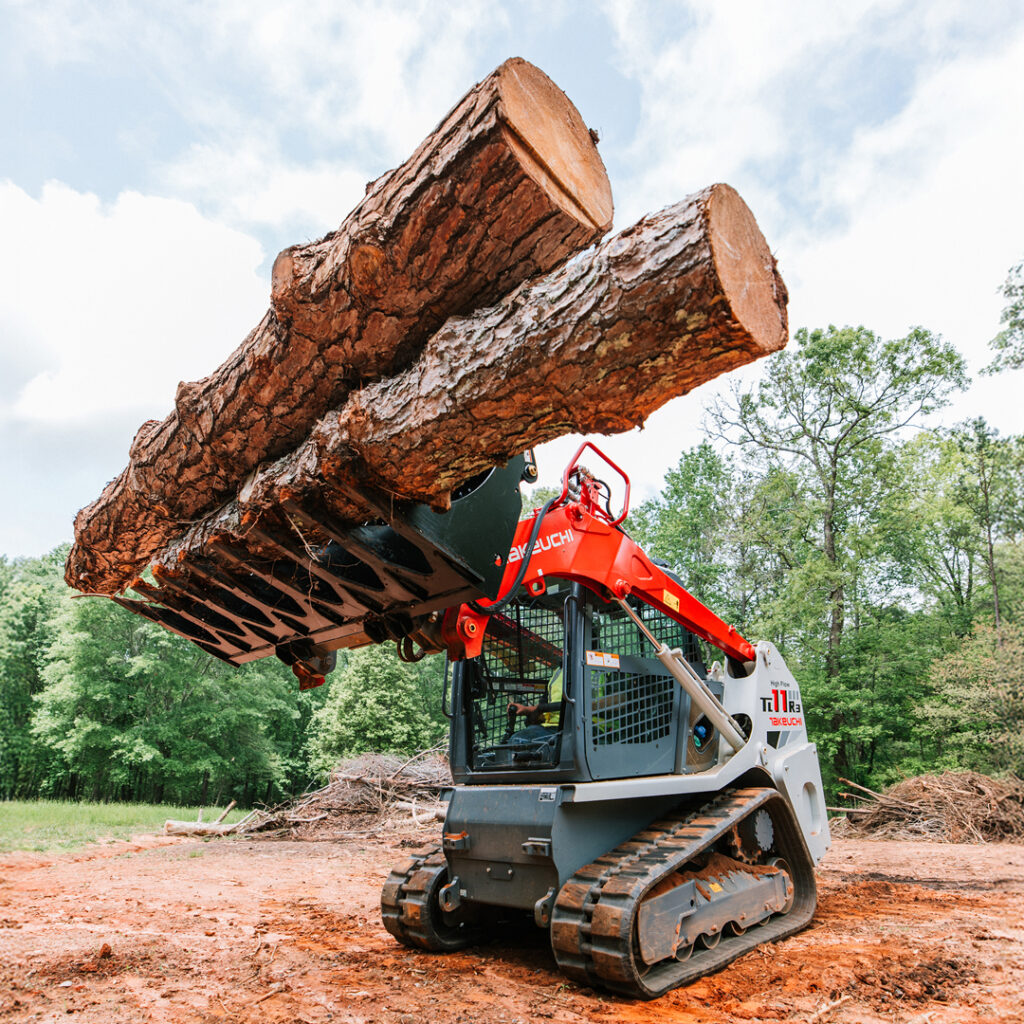
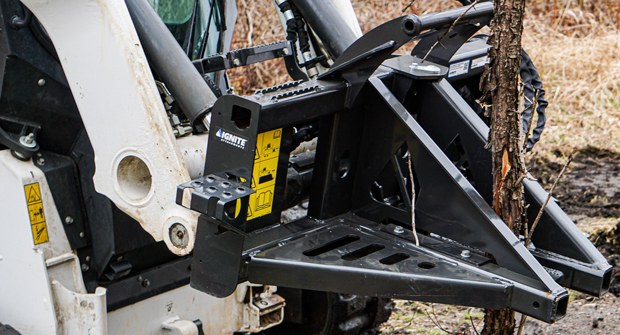
“So, we got creative, and we found a custom-made attachment for our mini excavator that looks like one of those arcade game grapplers, except this one clamps tightly on both ends of the blocks,” he says. “Now we can move and set these blocks much more safely and with fewer people than we were using before we had this attachment. It’s made us more efficient on the jobsite.”
Ramirez offers a prime example of how these tools — whether custom or part of a contractor’s “toolbox” of attachments — are game changers for landscape pros seeking more effective, efficient and productive use of their labor resources.
The national labor shortage is no longer just a headline for the landscape and lawn care industry. For many pros, it’s a daily operational hurdle. With skilled labor increasingly scarce, contractors are turning to compact equipment solutions to bridge the productivity gap.
But for these machines, whether they’re compact track loaders or walk-behind mini skid-steers, the real productivity solutions are found in what’s hanging off the front end. For professional landscape contractors, attachments not only make small crews more effective, but they also protect the bottom line.
While every landscape contractor has their go-to attachments — buckets, forks and augers — the idea that attachment technology has reached its peak is a myth. As landscape trends change, such as the rise in complex hardscaping or large-scale landscape projects, industry insiders say manufacturers are engineering more sophisticated tools to meet contractors’ changing needs.
Addressing labor
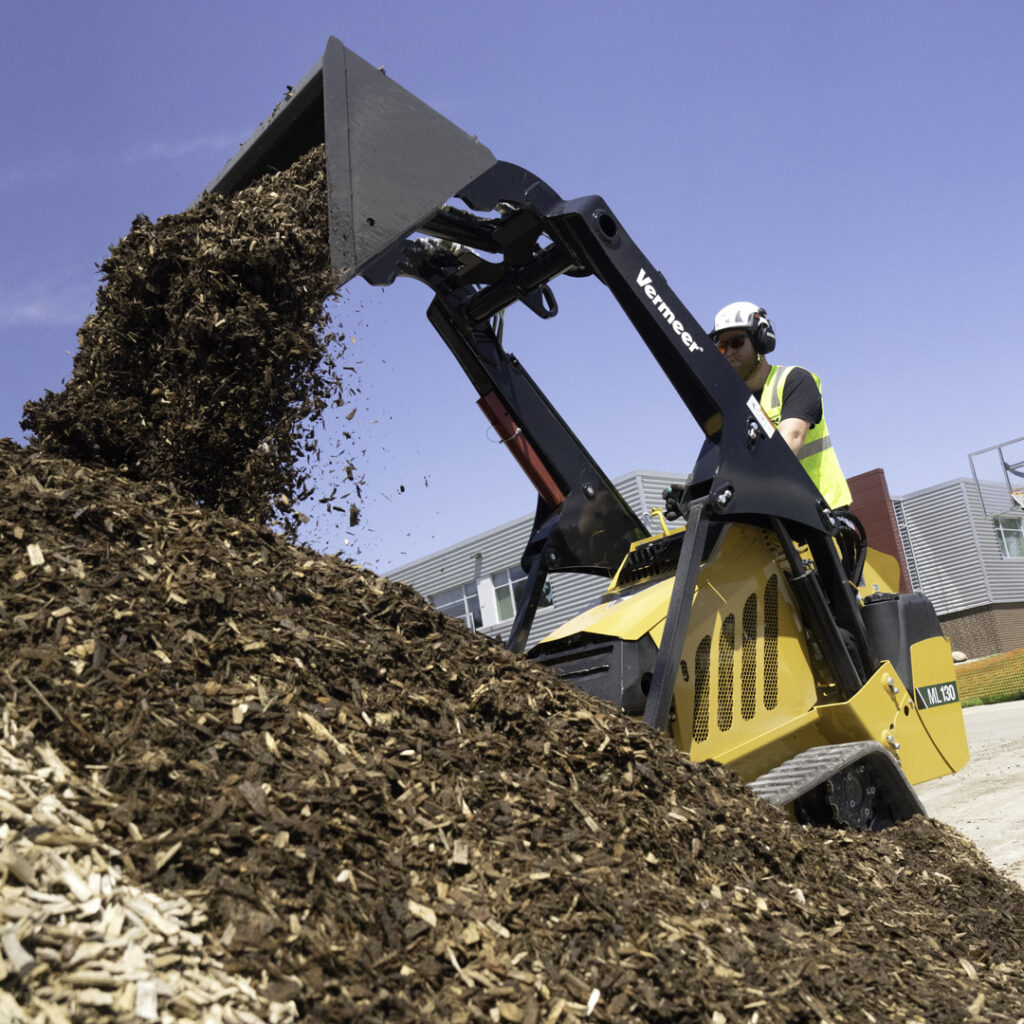
Compact skid-steers and loaders were introduced to tackle physically demanding bucket and fork tasks that were proving difficult for landscape contractors to staff. The modern shift toward diverse attachments has allowed contractors to allocate their available workforce to higher-value, revenue-generating activities, says Kegan Strobel, a product specialist at Vermeer.
“Not only are you saving labor by putting these attachments on, but you’re lowering the costs of what it takes to enter the market,” Strobel says. “You may have started a landscape company with a specialized focus, such as hardscaping. Then, you may decide to expand into irrigation. Now, with the right attachment, you don’t need a specialized piece of equipment. You can address those niches and quote the whole job instead of subcontracting out some of the work you don’t have the labor to handle.”
The latest generation of compact equipment and attachments hitting the landscape market has been engineered to fill the gaps left by a shrinking labor pool, says Matt Walsh, a Caterpillar product consultant. It’s not a question of adding more power to the equipment, he says, but of creating a more seamless relationship between the machine, the attachment and the operator, ensuring that what has traditionally required the work of three laborers can be completed quickly and successfully by one.
“The attachments market is continually evolving as (landscape contractors) find new markets they want to serve and expand into,” Walsh says. “Our customers and dealers continually share ideas for improving our current portfolio of attachments and request new tools to be designed and brought to market.”
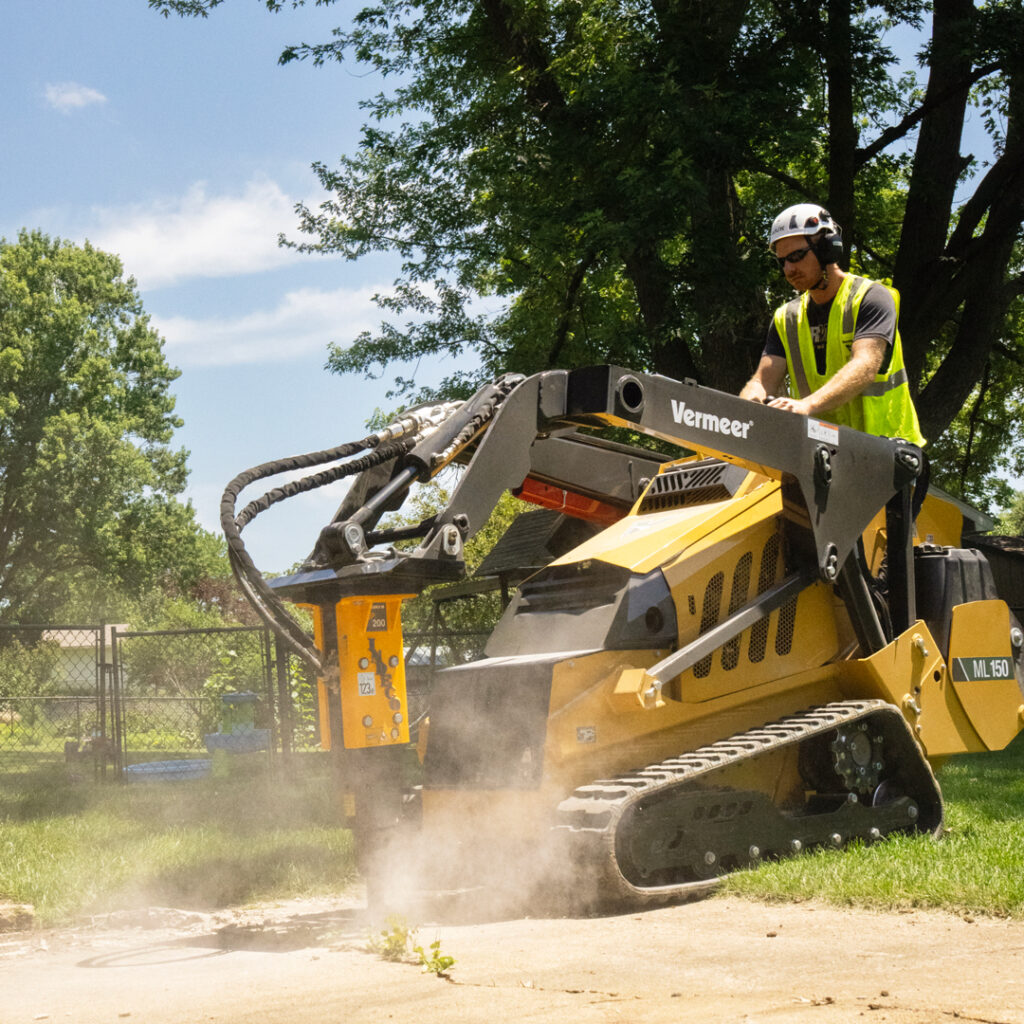
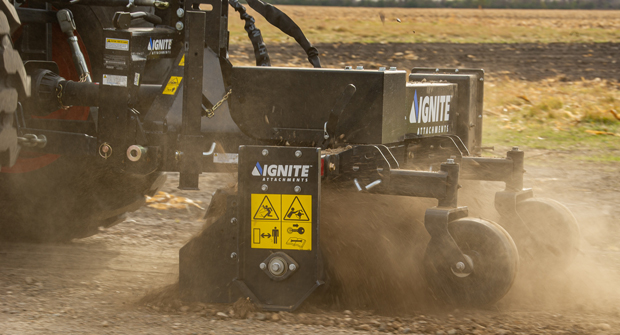
These compact tools offer a level of versatility that far exceeds traditional manual labor, says Darin Gronwold, product manager for Ignite Attachments. For example, a compact skid-steer or excavator with the right combination of attachments allows a single operator to perform the work of an entire crew by swapping between these specialized tools.
Gronwold says the “one-carrier, multiple-tasks” approach is particularly effective in tight residential or commercial locations where larger machinery cannot maneuver effectively.
“You can have one (compact loader) with a half a dozen attachments that all do a little different job supporting one operator,” Gronwold says. “You can do so many more things. It’s a lot better than a wheelbarrow and a shovel.”
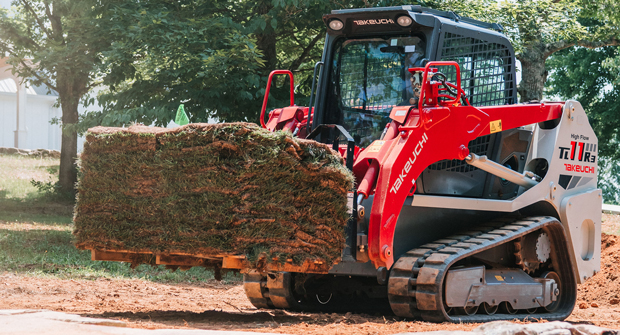
For contractors, attachments come down to saving time and getting consistent results for repetitive tasks. For example, Scott Utzman, product manager for attachments at Takeuchi-US, says if a contractor is burying irrigation pipe or low-voltage wiring, then a trencher attachment is a good match. Or, if a contractor is planting numerous trees or fence posts, an auger attachment will produce uniform holes without a lot of extra effort.
“That’s a big deal when you’re trying to wrap up a job and move to the next one,” he says. “It also opens the door for contractors to do more types of work, even with fewer crew members. One compact machine with a bucket, forks, auger, trencher and a rake can handle a lot of what a landscape business needs day to day.”
Purpose-built designs
The evolution of attachment development is shifting toward units with specialized efficiency and seamless machine integration. Utzman believes the focus has shifted away from multipurpose tools in favor of purpose-built designs.
“Instead of trying to use a single attachment to handle a bunch of different tasks, attachments are being designed to do specific tasks really well, whether that is trenching, grading or clearing brush,” Utzman says.
Ignite’s Gronwold says attachment manufacturers are utilizing cutting-edge engineering technology in the design and construction of their latest-generation products. For example, advanced software runs structural simulations and computerized predictions known as finite element analysis (FEA) to predict how products and their structures react to real-world physical forces, including stress, heat and vibration.
“We can plug in (jobsite scenarios) that this size machine is lifting something that’s this heavy on this corner of the attachment, and it’ll show the weak areas,” he says of this advanced testing. “We can reinforce those weak areas, but we can also keep the weight down on that attachment. A lot of times, people think a heavier attachment is a better attachment because it has more steel, making it heavier duty. But really, that’s not always the case. What really matters is where the gussets are and where the strength is built into the attachment. So, we’re always tweaking and finding new ways to improve a tool.”
Utzman agrees, adding that durability has emerged as the primary concern with landscape pros purchasing attachments. Throughout the course of a day or a project, buckets, mulchers, grapplers and power rakes must endure extreme operational stress. As a result, Utzman sees a clear trend toward utilizing high-strength construction materials and superior wear components on attachments.
“Where (technology is) evolving is how those attachments perform,” he says. “For example, grading attachments are getting better at producing a clean finish with fewer passes, and brush cutters are becoming more efficient at handling thicker material.”
From the landscaping frontline, Ramirez says his crews place value on durable attachments, but maintenance issues happen on the jobsite. Having attachments that are easily serviceable in the field is also key.
“These tools take a lot of wear and tear throughout the day. … It’s what they were designed to do,” he says. “Having the ability to replace a hose or fix a coupler easily keeps crews on schedule.”
While the primary focus is specialization, Utzman says there is a secondary push for intelligent versatility and developing tools that reduce the frequency of switching between attachments.
“Anything that helps save time or improve the final result is going to be valuable,” he adds. “I don’t think we’ve hit an endpoint (with attachment development). It’s just more about refining what’s already out there and making it work better for the way contractors use it.”
And the notion that attachment innovation is dead couldn’t be further from the truth. For example, Strobel says Vermeer recently launched a 9-cubic-foot-capacity concrete mixer attachment for the construction industry, which allows operators to mix materials while simultaneously controlling the discharge door for seamless on-site placement.
“It’s something that we could potentially see landscapers use for hardscape projects like block walls or block patios,” Strobel says. “The great benefit is that you could bring the mud right to where you’re working, and you don’t have to use a wheelbarrow.”
Machine and attachments
Advancements in engineering have improved the synergy between the attachment and the machine that powers it. Utzman says this is evident in the refined operation of trenchers and augers, as well as the more consistent power delivery found in the latest generation of brush cutters.
“Better hydraulic performance and quick couplers make a difference (for landscape crews) switching between attachments throughout the day,” he says.
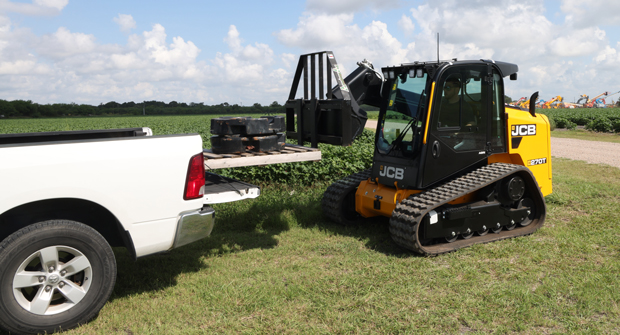
However, attachments are only as effective as the equipment powering them, says Lee Tice, JCB’s senior product manager for compact equipment. Advances in compact equipment technology directly affect an operator’s field performance, especially when managing repetitive tasks.
The main principle of compact equipment and its attachments is to make the operator as efficient as possible on the jobsite, and advancements in machine controls are central to that goal, Tice says. Advanced software and high-tech in-cab controls allow the user to operate attachments with enhanced precision, which is essential for high-finesse landscape rakes.
“This eliminates the need to constantly feather the joystick, ensuring a more consistent finish and reducing (operator) fatigue,” he says.
Additionally, advanced software allows an operator to set and save their individual profile for the machine, which customizes the controls to their liking and their on-site needs, Tice says.
“They can (customize the controls) to make it feel like their favorite machines,” Tice says. “He may want to slow things down for more precision work or working in tight spaces, like a backyard. Now, they don’t have to worry about the machine having one setting for hypersensitivity.”
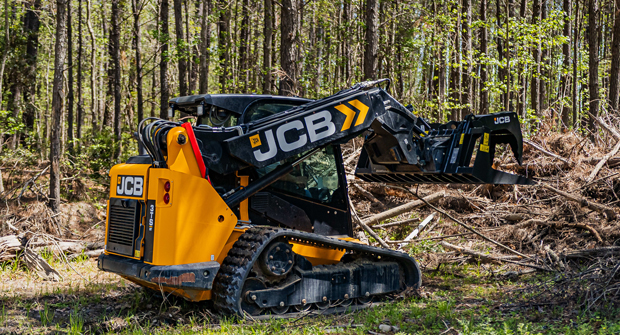
Another example of an improvement that benefits both the machine and its attachment is JCB’s telescopic arm. With 8 feet of forward reach, Tice says it redefines the limits of a compact loader by consolidating the functions of multiple units into one. In landscaping applications, the extending boom enables the operator to reach over existing structures, trenches or fragile terrain, increasing the unit’s productivity and reducing the labor needed to troubleshoot complex site scenarios.
“So, I can now boom that bucket (attachment) out in front of me,” Tice says. “Augers are one this is particularly good for. … Now I can put that auger out in front of me and see the bit. You can control the bit with the boom extension, so you’re not having to move the machine to control the bit. It really expands the applications of the skid.”
The evolution of control and compatibility reflects a significant generational leap, as well. While older machinery often limited operators to a few basic functions, Ignite’s Gronwold says contemporary units offer sophisticated precision through joystick-integrated controls, almost like a video game.
“Today’s operators expect to execute complex maneuvers, such as angling and tilting attachments, with a simple touch, mirroring the intuitive responsiveness found in modern digital interfaces,” he says. “This heightened functionality caters specifically to a younger workforce that views high-tech cabins not as a novelty, but as an essential workspace.”
Forward thinking
The landscape industry is witnessing a pivotal shift, as new technology, such as automated machines and battery-powered units, moves from pure concept to jobsite reality.
While battery-powered technology is advancing in landscape equipment and fits well with mowing and maintenance tasks, Utzman believes heavy-duty applications, such as running brush-cutting or trenching attachments, still require greater hydraulic flow generated by internal combustion engines to ensure adequate power and runtime. Despite the advancements in battery technology, diesel and gas engines still hold the advantage for high-demand tasks, he adds.
“Right now, it’s not really about battery-powered equipment replacing traditional equipment,” Utzman says. “It’s more about having options and using what makes sense for the job. Electric will keep growing, but traditional equipment isn’t going anywhere anytime soon.”
Modern technology allows contractors to program equipment for precise tasks, such as excavating to precise dimensions, and it will require a parallel transformation in attachment design, Gronwold says.
“We’re going to have to start thinking about hydraulic actuators on grapplers and things like that that can cater to (battery-powered) machines that don’t have fluids and motors for continuous hydraulic flow,” he says.
He emphasizes that attachment manufacturers must remain forward-thinking in their engineering to ensure compatibility with emerging compact equipment platforms, even innovating ahead of the curve by developing attachments tailored for unmanned operations.
“We’ve been thinking about creating something that’s more Bluetooth (enabled) on the attachment side, where you can attach it to a (compact machine), and then it runs off of Bluetooth,” he says. “As an attachment manufacturer, we have to keep our eyes out front to know what’s coming.”
While the rapid pace of change presents a significant challenge, staying at the forefront of automation and electrification is a strategic necessity for the future of the compact equipment market.
“We have to be ready and make sure we’re compatible for (next-generation) machines,” Gronwold adds.
Utzman says it always comes back to greater efficiency — faster attachment changes, better performance and greater control to cut through tasks more quickly while still delivering quality results.
“At the end of the day, (landscape contractors) are looking for tools that help them stay productive and competitive, especially with the labor challenges they’re dealing with,” he says.