 SUBSCRIBE


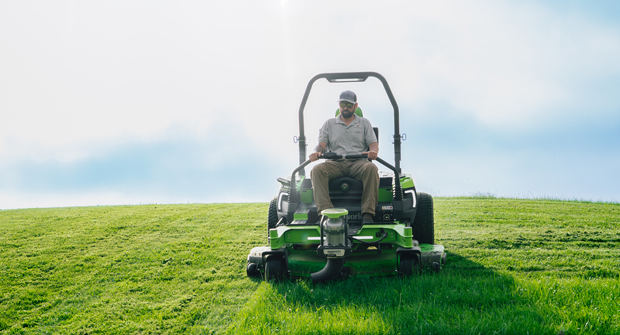
David Reeves has been in the landscaping industry for about 30 years now, having worked a few different jobs for some of the largest companies in the business. Now, he’s settled in the Dallas-Fort Worth area as the vice president of landscape maintenance at Site Landscape Development, a full-service commercial landscaping company focusing primarily on large warehouses and HOAs.
He’s been a partner with John Deere for the past nine years, eight having been with the same dealer, five with the same rep and three of them with some extra direct support that allows Reeves to test the newest innovations John Deere has to offer.
“We’re a pretty heavy tech-focused landscape company,” he says. “Six years on Aspire at this point, our entire truck fleet is GPS — when we get our next set of mowers here, our entire fleet of mowers will be GPS.”
As a company that has roughly 60 crews, 80 mowers, three Gator utility vehicles and more, Reeves says it’s important to stay up to date with the latest trends in mower innovations, as well as the technology and software that keeps everything connected. By staying ahead of the curve, he’s often saving thousands of dollars and hundreds of hours every time something new gets added to his operation.
So, whether it helps with saving labor, money, time or peace of mind, here are the most important innovations in mowers and turf equipment that landscape pros and industry experts like Reeves are talking about.
Automation is everywhere… almost
You’ve probably heard it all before — maybe even from the pages of Landscape Management a few times — but the advancements in automation and robotics for mowers is easily making this technology one of the hottest industry topics.
Lenny Mangnall, marketing product manager for Exmark, says autonomous mowers have changed rapidly in the last few years, and he remembers how the technology started with small, wire-guided machines for homeowners. Now, it’s become viable for landscapers to run them in their fleets for large properties.
“Today, it’s kind of a boom, right? It seems like every month there’s a new manufacturer coming to light with some level of autonomous mode,” he says.
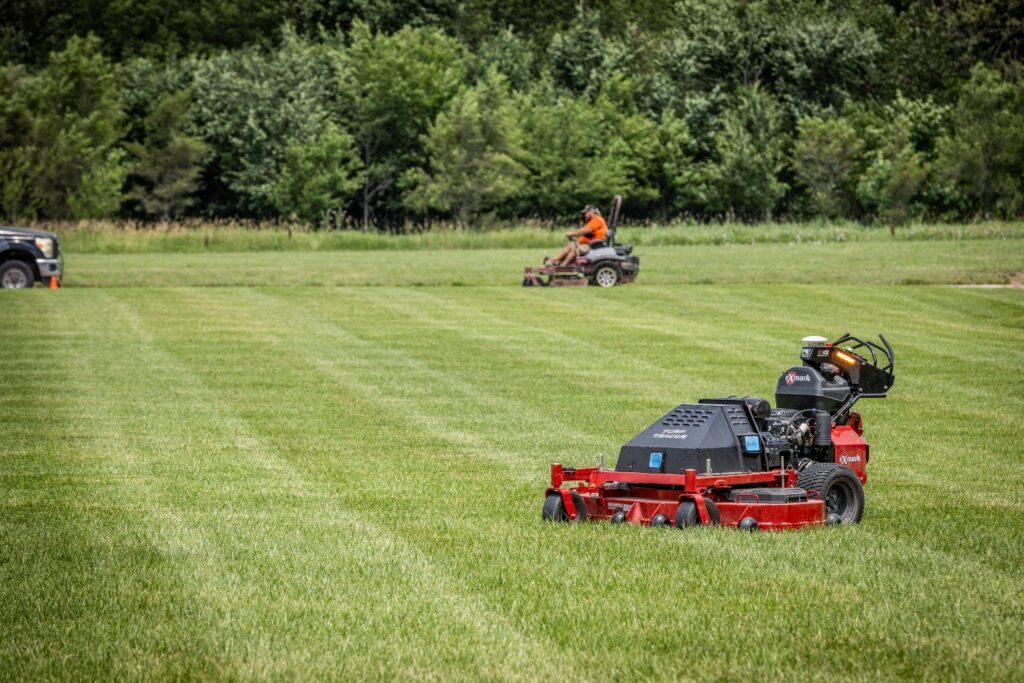
Exmark uses a “supervised autonomy” system with their Turf Tracer autonomous mowers, he explains, meaning the perimeter of a site is mowed manually, any exclusion/no-go zones are logged, and then the mower calculates the most efficient way to mow the property. And while this system isn’t perfect — being more ideal for large, open turf areas and repeatable jobs — it shows how quickly autonomy has grown from the simple wire-guided bots in its early iterations.
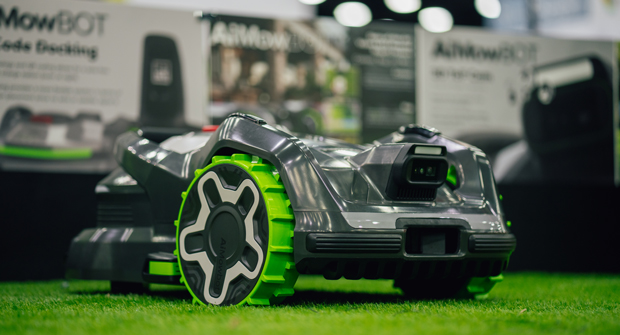
Part of autonomy’s fast-paced growth can be attributed to the technology trickling down from other industries, especially automotive and agriculture spaces. Robotic mowers have seen a similar trajectory, and one of the biggest developments with them is their size, now seeing them grow large enough to move away from the residential space and into commercial properties.
But while the power of multiple industries pushing this technology forward can mean that mower innovations happen sooner and with better efficiency, Mangnall also says landscapers should make sure they invest in trusted companies, especially ones that are able to provide landscaping-related support.
“It’s not a roll-away piece of equipment that you’re buying, it’s a long-term investment,” Mangnall says. ‘You just want to ensure that, if you purchase a piece of that equipment, that you’re partnering with a company that is on stable ground and has real interest in the industry itself.”
Battery boosts
Another innovation that is starting to find its footing in the mower and turf equipment space is electrification, especially thanks to the improvements made to batteries and charging infrastructure.
Jeff Richlen, vice president of turf and consumer products at Briggs & Stratton and Ferris, says these improvements and their adoption into the industry have been driven by necessity. As more regions, municipalities and HOAs look to enforce zero-noise and zero-emissions goals, ensuring battery-powered technology can keep up with its gas counterparts has become a major motivator.
“If I’ve learned nothing else in my four years with the company, it’s that (landscaping) is an industry that is very pragmatic in what it does, and it moves a little bit slower than, let’s say, automotive as an example,” Richlen says. “Therefore, if there’s a need, and the technology or the advancements or the sophistication addresses that need, then you’ll see it be adopted much faster.”
Caleb Myers, sales representative for Steel Green Manufacturing, agrees with that sentiment, and he says this desire for better batteries has seen Steel Green’s electric spreader/sprayers become significantly more powerful and reliable.
“The battery packs that we’re using now, we are incredibly confident in it,” Myers says. “The original units we were testing, we’d have to put two, three, sometimes four batteries in one machine, whereas now they’ve developed one, larger battery that can withstand the performance that we need throughout a day.”
Like autonomy, batteries in landscaping equipment have benefited from the innovations in other industries, but it also helps that companies like Briggs & Stratton have the capabilities to find their own improvements. Richlen says Briggs & Stratton has its own battery division, meaning they’re able to tailor that technology to their own machines, ensuring it’s optimized for the purpose of landscaping and mowing.
“Because we have our own battery systems, we benefit from having access to some of the best cells and cell chemistry and form factors in the world,” Richlen says. “The products that we actually offer today and sell today, whether it be the batteries, the motors and the controllers … they’re very deliberate and purposeful in how they’re produced for the application.”
And as electrification continues to increase power, efficiency and runtimes, operators should see more benefits outside of the standard noise and emissions reductions. Greenworks Commercial’s Tony Marchese, senior vice president of sales, Commercial Business Group, Americas, says the maintenance on products like battery zero-turns are much lower than gas, leading to more uptime and significant productivity gains.
Labor shortages are another driving factor in improving battery technology, and Marchese says putting operators on newer electric machines is helping companies
with employee retention.
“The progressive landscapers are attempting to draw in better operators, and one of the ways that they do that is by putting them on battery products, which at the end of the day, they’re far less fatigued,” he says. “The amount of vibration, or the amount of noise that they must face on a gasoline zero-turn, is gone. And at the end of the day, they don’t come home smelling (and) ingesting both two-stroke and four-stroke gasoline products, which then makes them feel better and more fulfilled.”
Staying connected
Autonomy is separating the operator from the machine in ways the industry hasn’t seen before, but on the other hand, turf equipment has never been more connected to the business and its managers.
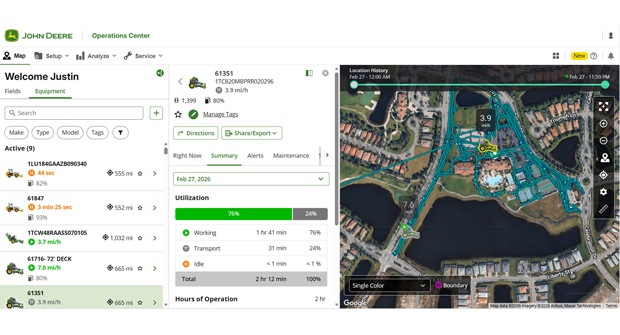
And while electrification and autonomy might not be fit for every operation, fleet management and software upgrades are much more digestible. Reeves, for example, has been a big advocate for John Deere’s JDLink Modems, which connect to machines regardless of equipment or age and transfer machine and field data to his John Deere Operations Center account.
He says this kind of fleet management and machine monitoring system helped tremendously with labor hours and ensuring his mowers are where they’re supposed to be. He even recalls one time when he beat the police to finding roughly $100,000 in stolen equipment because it was hooked up to a GPS system.
On top of that, having new software that can send reports on job efficiency and equipment status means Reeves has been able to improve his operations automatically, without needing someone to waste time monitoring and logging all that data themselves.
“You’re not relying on somebody to manually track when an oil change is due. We’re now getting an email or a text message that says, ‘Hey, this piece of equipment is due for an oil change,’ and we can schedule that,” Reeves says. “It’s probably given somebody 10 hours back in their week. It’s probably also saved us several thousands of dollars a year in unneeded or preventable repairs.”
Similarly, Exmark has its recent Horizon360 software, a system that connects fleet management, diagnostic reporting and efficiency monitoring to its overall business management platform, showcasing how mowers and crews can be further integrated into the larger picture of running a landscaping company.
Horizon360 can help with fleet management, idle times, maintenance needs and more, all of which can significantly impact productivity and efficiency on a jobsite. But one issue Exmark’s Mangnall sees with these connectivity improvements is that they’re not fully adopted by the industry yet, or at least not being taken advantage of to the fullest.
“I think a lot of manufacturers already have a lot of this connectivity built and ready to go. It’s just helping the industry understand how can they use this to (their) benefit, right? How can they use it to make themselves more efficient, more profitable?” Mangnall says.
Sprayers have also seen some recent software improvements, such as with Steel Green’s Razor Tracking and Opti-Rate systems. Myers says Razor Tracking is another advanced telematics system that allows users to monitor where their Steel Green machines are and how they’re being used. It can also set up maintenance reminders and intervals.
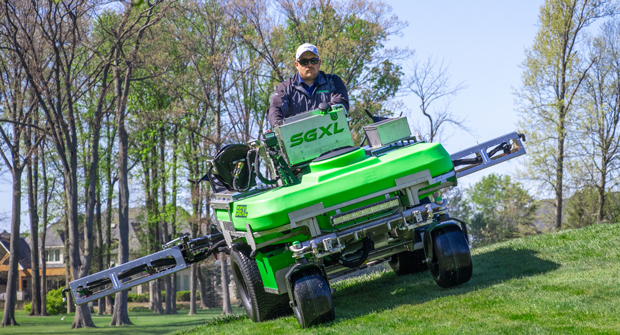
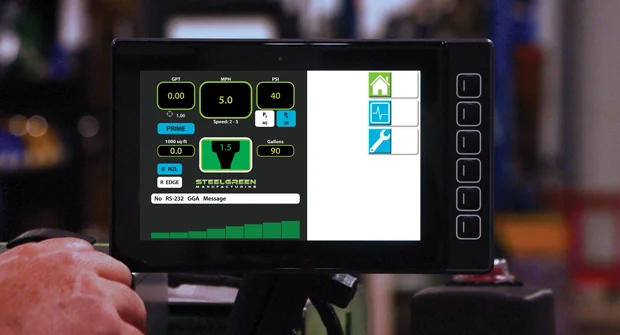
As for Opti-Rate, this technology is a pulse width modulation rate-controlled spray system that reacts to what the machine does to ensure a consistent spray rate and spread. Myers says through turn compensation and reacting to speed or elevation changes, the system gives operators peace of mind that the application is going down properly and efficiently, also saving on chemical costs.
“(The screen) also has a visual bar graph that gives you visual feedback of how the nozzles are pulsing and changing,” Myers says. “That’s also a built-in troubleshooting feature, because if something goes wrong with a nozzle or solenoid, it’ll flash on the screen, give you a fault code, and then we can diagnose it on the spot and figure out what’s going on.”
Old dog, new tricks
Technology is everywhere now, but sometimes it can be nice to return to ol’ reliable and just take the mower for what it is. Despite all the electronic bells and whistles that are dominating the turf equipment dialogue, improvements are still constantly coming online for the more old-school, mechanical side of these machines.
Reeves says Site Landscape Development runs their zero-turns hard, and switching to John Deere’s Michelin/Tweel airless tires has better kept crews running without the financial or time-consuming hassle of getting a flat.
“We’ve been doing that for five or six years already,” Reeves says. “When we switched over, that was a game changer. We literally are not spending $3,000 a month on tires (anymore).”
Mower decks have also been seeing some huge improvements, and multiple systems exist to increase the capabilities and versatility of each machine.
Greenworks’ Marchese says 72-inch and 96-inch decks on mowers weren’t as popular a decade ago, but now with the pressures that come from labor shortages, landscapers are looking at larger sizes to do more with less people (He says he’s seeing this size increase happen with autonomous mowers, too).
“It wasn’t even a thought to some degree, and needs are changing for landscapers, because as they struggle to maintain or attract employees, then they’re going to need to do much, much more with the employees that they have,” Marchese says.
Exmark has its own deck innovation with its Adapt technology, which enables quick and accurate deck rake adjustments from the operator position in a matter of seconds.
“That’s something that has really created a buzz for us and been widely accepted as a great feature — great innovation,” Mangnall says.
Ferris has aimed to set itself apart with its independent front and rear suspension system and deck compensation, which Richlen says is a massive benefit for operators using the machines on a daily basis.
“It takes the load off the operator. It takes the load off the chassis. It makes our machine more durable,” he says. “We also have deck compensation, and what that means is, as the vehicle goes over rougher terrain, the deck stays true to the earth. And that deck compensation is really part of the secret sauce of why we excel in the space to maintain our quality of cut even on that rougher terrain.”