 SUBSCRIBE


Last month’s Turf School article featured a Q&A overviewing annual bluegrass weevils, a small, Northeast and Mid-Atlantic snout beetle known for being a headache for lawn care operators (LCOs).
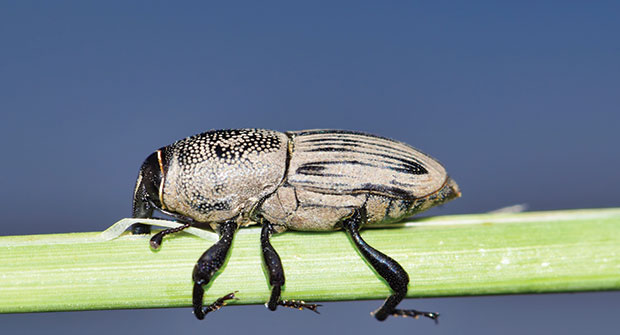
This month, the beetle lessons continue with a rundown on billbugs, a pesky weevil commonly infesting lawns and killing the turfgrass around late spring when the days start to become warmer and longer.
On the ground
Brian Feldman, senior director of technical operations at TruGreen, has more than 30 years of experience in the agronomic and horticultural industries, and he says the best way to identify a billbug problem is to be up close and personal.
“Scout and assume the position. What position, you may ask? The position of kneeling down in the lawn and inspecting,” Feldman says. “If you don’t get into the lawn, you may miss the chance to see the symptoms and signs required to control this pest.”
While there are multiple different billbug variants, the most common two for lawns are the bluegrass billbug (Sphenophorus parvulus) and the hunting billbug (Sphenophorus venatus). Feldman says adult billbugs have a long snout that curves downward, and they’re usually blackish grey or even brownish in color.
“The bluegrass billbug attacks cool-season grasses across the United States, including Kentucky bluegrass, perennial ryegrass, fine fescues and sometimes non-endophytic tall fescue,” Feldman says. “On the other hand, the hunting billbug prefers warm-season and Transition Zone grasses, mainly zoysiagrass.”
And even though scouting for adults is important, it’s the larvae that do the most damage. Feldman compares the larvae to a white grub, only smaller in size with a reddish head capsule and no legs.
What’s the damage?
Billbug symptoms can often be misdiagnosed for drought stress, dollar spot and white grub damage, according to Feldman, meaning it’s important to be on the lookout for the right side effects.
“Billbugs damage lawn grass when the larvae bore into the stem of the turfgrass plants. This causes the plant to wither and die. The larger larvae then bore into crowns of the grass, killing entire plants,” Feldman says. “Lawns that have been injured by billbugs have grass that pulls up easily when tugged because of the hollowed stems and crowns. You might also find a fine, light brown ‘sawdust’ around the stem, crown and soil interface. This sawdust is the frass of the billbug and a key indicator you have an infestation.”
The result is initial brown spots that can turn into larger dry and patchy areas, resembling drought.
Control the problem
Preventative measures for billbugs can give LCOs peace of mind, and one of the best ways to ensure this is through good cultural practices. Proper mowing and watering techniques, for example, are reliable ways to support a healthy lawn that’s more resistant to pest attacks, Feldman says.
For chemical management, he recommends professionally applied preventative control products designed to enter the grass systemically, preventing vast damage from the larvae.
“In addition, a control application made in the spring to control the adults has also shown to be another good defense measure, especially on lawns known to have infestations in the past,” Feldman says.
Feldman also recommends selecting sod or seed that is resistant to insects and diseases.
“If you do not overseed your lawn annually, consider doing so to introduce improved varieties of grass that are more resilient and tolerant of insect damage,” he says. “The best cool-season grass varieties on the market now contain endophyte, which is a natural symbiotic fungus that helps turfgrass survival, including tolerance to insects, drought and disease. The endophytes live inside the grass’ tissue and produce alkaloids, which are toxic to feeding billbugs and many other surface-feeding insects and diseases.”
Turf School is brought to you by Quali-Pro.