SUBSCRIBE


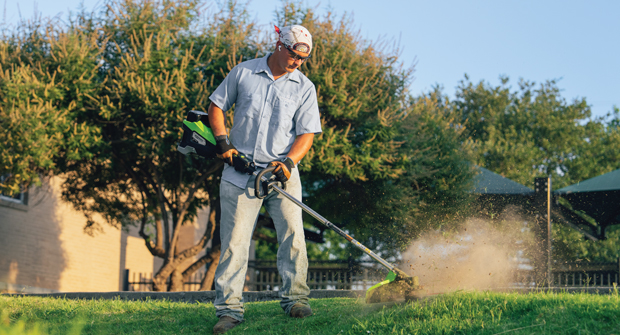
Labor shortages continue to reshape the landscape industry. While demand for landscaping services remains strong, contractors are finding it increasingly difficult to recruit and retain qualified employees. Rising operating costs and increasing customer expectations are placing even greater pressure on crews to accomplish more in less time.
For many landscape businesses, the most valuable asset is a productive employee. As a result, contractors are evaluating equipment based less on horsepower and more on whether it helps crews complete more work, reduce downtime and improve profitability.
The answer often comes down to operational efficiency.
Every landscape contractor knows how quickly a productive day can be disrupted. Repairs, refueling and routine maintenance may seem minor, but over time they translate into lost productivity, delayed schedules and fewer billable hours. In today’s labor market, businesses cannot afford unnecessary downtime.
Battery-powered commercial equipment has become a much larger business conversation than it was just a few years ago. While early discussions centered on emissions and sustainability, contractors are now recognizing its operational advantages. By eliminating oil changes, spark plug replacements and fuel management, battery-powered equipment reduces maintenance, minimizes unexpected downtime and keeps crews focused on serving customers rather than servicing equipment.
The operational benefits also extend beyond maintenance. Contractors are finding that battery-powered equipment can significantly reduce fuel costs while eliminating the time crews spend leaving jobsites to refuel.
“Gas savings are huge. None of our onsite crews use gas anymore. We used to come close to our credit limit on our gas cards every month, and now we’re not even hitting 50 percent. Crews never have to leave the property to refuel, eliminating 30-40 minutes a day spent making gas station stops,” says Shawn Logan, president of Phoenix Landscape Solutions in Orlando, Fla.
Contractors are also rethinking how they build and manage their fleets. Integrated battery ecosystems that connect handheld equipment, commercial mowers and charging infrastructure can simplify training, reduce complexity and improve consistency across crews. Greenworks Commercial’s Optimus Crew platform reflects this approach by bringing together equipment, battery technology and fleet solutions that help crews stay productive throughout the workday.
Technology is also helping maximize limited labor resources. Connected fleet management systems provide visibility into equipment usage and battery performance, while autonomous technologies such as robotic mowing can handle repetitive maintenance on appropriate properties. This allows skilled employees to focus on higher-value work, customer service and projects that require their expertise. The goal is not to replace employees, but to help every crew accomplish more.
Another factor that deserves more attention is the employee experience. Equipment that is quieter, produces less vibration and requires less routine maintenance can contribute to a more comfortable work environment. As contractors continue competing for qualified employees, investments that improve day-to-day working conditions can support both productivity and workforce retention.
“Previously, we had used units (backpack blowers) that only ran battery for 20 minutes, and these Greenworks units have the ability to run battery for 45 minutes, sometimes more, depending on the speed of the throttle,” says Danielle McFall, CEO of McFall and Berry Landscape Management in Annandale, Va. “We have found that Greenworks, in terms of weight for comfort for our employees, as well as battery runtime, exceeds any other company that we’ve previously tried.”
Labor challenges are unlikely to disappear anytime soon, making efficiency more important than ever. Contractors that evaluate equipment based on long-term operational value rather than purchase price will be better positioned to reduce downtime, simplify fleet management and help every employee accomplish more.
Increasingly, battery-powered equipment is proving to be more than an alternative power source. It is becoming a smarter business strategy for the future of commercial landscaping.