SUBSCRIBE



In the professional landscape and lawn care industry, discussions about innovation often gravitate toward equipment and software. In recent years, breakthroughs in battery-powered, commercial-grade gear, the rise of autonomous mowers and the introduction of a host of business software solutions have stolen the spotlight.

And while that tech dominates industry headlines, advances in turf-and-ornamental (T&O) chemistries and precision irrigation management are often overlooked, despite being critical to a contractor’s bottom line. Equipment captures attention because it directly shapes daily operations, while agronomic and irrigation innovations quietly transform what happens beneath the soil. To drive margins and client retention, contractors must balance these diverse technologies so they work in concert.
Here are some of the latest agronomic and irrigation innovation trends that product experts believe contractors need to know heading into 2027.
Agronomics
According to manufacturers in the turf-and-ornamental-chemistry market, professional landscape contractors are driving the need for product innovation as ongoing labor shortages pose a long-term, if not permanent, challenge to their operations.
Reshaping labor
No one is immune to the labor crisis. It impacts both large-scale landscape operations struggling to staff rapidly expanding property portfolios and smaller firms striving to scale up while retaining reliable workers, says Lindsey Hoffman Chappell, Ph.D., a Green Solutions Team specialist at Envu. The Cary, N.C.-based company manufactures a broad range of herbicides, insecticides and fungicides for the professional lawn care market. These contractor-level realities shape manufacturers’ product pipeline.
“One way that we guide how we move as a company is by having our connections with lawn care operators and hearing their pain points,” Hoffman Chappell says. “And then there’s a cost per 1,000 square feet that (the contractor) needs to get to. So, how do we (introduce products) that make them as efficient and as effective as possible?”
Key to this strategy are active ingredients that offer long residual control and highly flexible application windows. These allow operators to apply products earlier or later in the season while maintaining extended efficacy, Hoffman Chappell says. By ensuring the chemistry remains active in the soil over a longer duration, contractors can reduce costly callbacks, thereby saving labor hours, reducing fuel expenditures and keeping trucks focused on generating new revenue.
“You don’t need to go back and make multiple applications,” she says. “The residual sticks around, and that ultimately is going to reduce callbacks, which can take people away from properties they need to treat.”
Greater control
Beyond the development of single active ingredients, innovation is also driven by the creation of sophisticated combination products and comprehensive treatment programs, Hoffman Chappell says. Manufacturers are streamlining labor by blending proven active ingredients into a single, unified formulation, such as addressing broadleaf and grassy weeds in a single application.
“I look at it like a triangle approach,” Hoffman Chappell explains. “What’s the problem? What products do we have available? And how can we put a program together that will make contractors effective and efficient? And it really starts with listening to the marketplace and determining how we can be innovative in that space.”
In response to labor challenges among landscape and lawn care professionals, Paul Giordano, Ph.D., director of agronomy at Harrell’s, says there’s been a significant surge in the adoption and use of plant growth regulators, or PGRs.
While PGR technology is not new, its popularity has grown exponentially because it slows turf growth, drastically reduces mowing frequency and simultaneously promotes healthier turfgrass, according to Giordano. “And we’re seeing better formulations, better use patterns and research trials to explore different uses (of PGR chemistry) that are somewhat untapped,” he says.
Looking toward the future of PGR development, Matt Giese, technical service manager for Syngenta Professional Solutions, emphasizes the industry’s need for enhanced residual control and improved plant safety. The next generation of growth suppression will likely stem from formulation advancements, the discovery of new active ingredients or innovative combinations of existing market products, he says.
Ultimately, the goal of these technological strides is to maximize the safety and longevity of growth regulation, elevating the standalone performance of current products into more robust, labor-saving solutions for landscape contractors.
“Maybe that’s a new active ingredient, or maybe it’s a combination of current products that we have on the market that we’re able to mix together,” Giese says. “There are a few options out there, but what does that really mean in terms of being able to enhance the benefit that we’re already seeing from some of those individual solo products?”
Shifting timelines
While T&O manufacturers’ primary objectives remain centered on product safety and efficacy, their technological advancements and product innovations often streamline field operations for contractors.
For example, white grub management strains contractor labor and budgets. Historically, traditional insecticides demanded precise, peak-season applications in early July, frequently requiring costly follow-up treatments that squeeze margins.
The introduction of highly effective diamide chemistry shifted this paradigm by offering extended residual control, according to Giese.
“In essence, we’re tying in the safety piece and efficacy,” he says. “But as a by-product, you do your grub control in maybe the middle of May, and then you’re done for the season. The idea is, do we have something that maybe has a little bit longer residual, can last that extra period and maybe free up some hours for a landscape or a lawn care professional to do other things that require their time?
“Let’s face it, spring is a busy time, right?” he adds. “If you can free up some hours during that period of time (for work) that doesn’t require additional people … that’s absolutely a plus.”
Promise and pain points
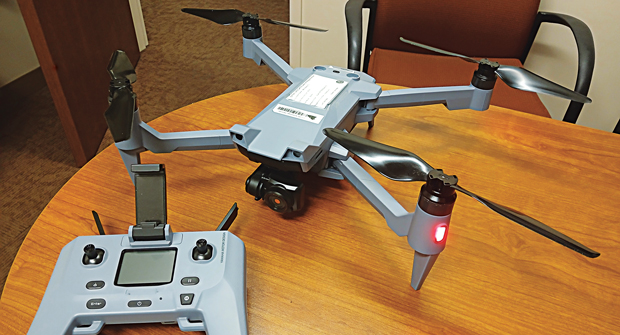
Drone technology’s potential for precision application has also caught the attention of the professional landscape industry. In agriculture, drones are increasingly used for precision pesticide applications. In the landscape realm, this next-generation technology offers significant labor-, time- and material-saving opportunities for contractors who manage residential estates or large commercial properties.
However, drones present a unique set of challenges for the landscape market regarding formulation and application data. None of the product formulations and testing standards for residential turf applications have been tailored for ultra-low-volume, high-precision delivery systems.
Hoffman Chappell emphasizes that existing chemistries cannot simply be translated from a standard ride-on or boom sprayer to a drone without rigorous validation.
“It’s not always an apples-to-apples comparison,” she says of precision drone spraying in ag versus landscape. “So, we must collect the data and figure out what that’s going to look like before we can make that jump. We want to make sure we’re giving the contractor the best advice that is supported by data.”
There’s a significant regulatory hurdle, as well. Giordano adds that most existing plant protection products lack specific label approvals for drone applications. While some products bear traditional aerial labels intended for high-altitude crop dusting, he adds that these regulations do not align with the ultra-low-volume, precise delivery systems used by modern drone technology.
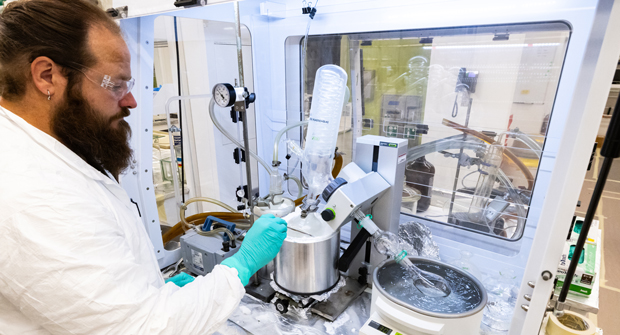
Consequently, the challenge shifts directly to product formulation, Giordano says. Although active ingredients and biostimulants have been proven effective under traditional conditions, manufacturers must determine whether they remain viable when applied at ultra-low water volumes using a drone or a modern precision spray unit.
“We need to be thinking on our end about how we can’t just put a product in a 2.5-gallon jug and expect it to be used like it always has,” Giordano says. “The game is changing, and we need to be very adept with formulations and understanding how these products can be used at very, very low water volumes, almost no water at all, where it’s almost straight products going down at a very fine application spray. Will it perform the same way we expect it to out of our traditional (spray) equipment?”
Ultimately, these innovations must help landscape and lawn care professionals assist their residential and commercial clients in maintaining healthy landscapes and turfscapes, Hoffman Chappell says. While contractors operate under very tight margins to provide these services, she contends that financial success and proper agronomics are fundamentally linked.
“Neglecting the agronomics behind turf health inevitably results in poor-quality (landscapes) and dissatisfied customers,” she says. “Chemical applications and mowing practices must function as a married entity, with products serving to support sound agronomic principles rather than replace them.”
Irrigation
Innovations in landscape irrigation are emerging simultaneously across software, hardware and service sectors, driven by internal corporate initiatives, manufacturing breakthroughs and vendor partnerships. Each branch seeks to assist landscape pros who provide irrigation services in improving end-user water efficiency and overall turf health, whether at commercial office parks, homeowners associations or typical residential yards.
Moreover, this next-gen technology can help contractors become better stewards of clients’ overall irrigation systems, increasing customer satisfaction while providing opportunities to strengthen contractor margins.

Targeting contractors
Chad Sutton, director of water management services at Sperber Landscape Companies in Westlake Village, Calif., believes the strategy behind how these technologies are marketed and adopted has fundamentally shifted.
Historically, Sutton explains, manufacturers pitched innovations in systems and controls management by highlighting direct advantages for property owners, such as reduced water bills and healthier landscapes. However, the industry has realized that widespread adoption relies heavily on appealing to the contractors who implement and manage these systems. Using cloud-based, mobile-accessible irrigation controllers as a primary example, manufacturers successfully shifted their messaging upstream to target contractors’ immediate, operational pain points.
“A lot of folks started talking about how this (next-gen irrigation technology) will help you save on fuel because you’re going to have fewer truck rolls,” Sutton says. “This will help with your labor crisis because you can understand diagnostically what an issue might be with a controller or a solenoid or a wire path without driving to the site and looking at it. This will help you be more efficient because you can streamline across a single platform for your entire portfolio.
“So, a lot of contractors now are investing in the technology directly for themselves, knowing that the clients will have the ancillary benefits of more efficient water use and a healthier landscape,” Sutton adds.
Smart and remote
Landscape companies offering irrigation services stand at a critical intersection between resource management and operational survival. With fewer than 10 percent of existing irrigation controllers in the United States connected to the internet, Haven Coleman, demand generation leader at Weathermatic, a Garland, Texas-based manufacturer of smart irrigation and water-conserving technology, says there exists a substantial opportunity to transition the remaining 90 percent into smart mode.
However, the driving force behind the adoption of modern irrigation innovations is no longer solely a desire for greater sustainability, which Coleman says has declined in relevance. Instead, contractors are upgrading technology out of sheer necessity to become more operationally lean and efficient.
“The water conversation and the labor conversation are kind of one and the same for most landscaping companies,” Coleman says. “When a (municipal) water restriction rolls out, contractors are forced to reprogram controllers, often by hand. They’re wasting thousands of hours of manual labor, drive time and resources (in the process).”
Innovations in next-gen smart controllers, according to Coleman, offer contractors the most flexibility to better service their clients while reducing the commitment of valuable labor and resources. Likewise, she adds that next-gen controllers will allow contractors to better fulfill their irrigation service commitments.
“Only about 20 percent of landscape contractors actually complete all of their contractually obligated physical inspections,” she says. “This (labor) bottleneck means crews often only visit a site after an irrigation failure triggers an angry client phone call.”
By transitioning to remote monitoring, Coleman says landscape contractors can improve inspection compliance, transform their reputation and reclaim valuable hours to reinvest directly in billable work.
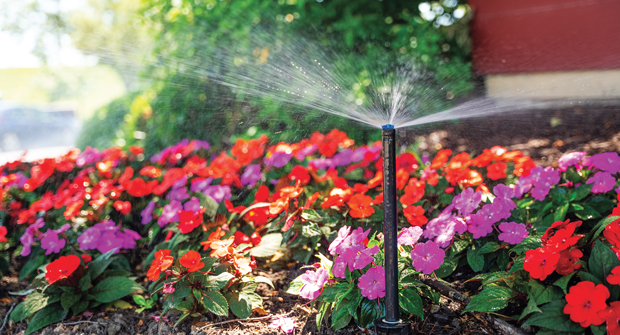
Contractors often overlook the true value of smart controllers by viewing them merely as glorified remote controls. This perspective overlooks the transformative operational and financial potential of innovative, smart, water-conserving systems. According to Coleman, these systems are easy to deploy, cost-effective and can improve a business’ bottom line.
“If contractors understood these three things, then I believe they’d see how achievable (smart controller technology) is to roll out,” she adds.
Tech’s problem
Chris Keating, an irrigation expert at Conserva Irrigation in Glen Allen, Va., which specializes in the design, installation and proactive maintenance of residential and commercial irrigation systems, offers a different perspective on next-gen innovation.
The landscape industry doesn’t suffer from a lack of innovation with irrigation technology, Keating contends. Rather, he says the industry regularly misuses or ignores both recent innovations and decades-old advancements designed to optimize water efficiency.
“The industry doesn’t have a technology problem,” he says. “We have an implementation and deployment problem. Innovations created over the last 20 years have been misused.”
For example, Keating points to the variable arc nozzle. Originally designed to accommodate unusual landscape angles that fixed nozzles could not cover, Keating says contractors have instead made it the default choice to slash labor costs by carrying a single, universal part. This short-sighted pivot disregards distribution uniformity and efficiency, resulting in wasted water, costly utility bills and poor plant health.
This pattern can be seen in smart irrigation controllers, too. “You get connectivity, but rather than use the product to its fullest extent to create efficient schedules, (contractors) program them like their old electromechanical controllers,” Keating says.
Keating challenges the prevailing industry mindset that evaluates new technology solely by how much labor it saves a contractor. Instead, the contractor’s primary responsibility is delivering a high-quality result by achieving true water conservation alongside structural efficacy.
This disconnect, according to Keating, becomes apparent during intense drought conditions and punishing evapotranspiration rates, like much of the country is experiencing this summer.
“If anybody thinks slapping a smart controller on the wall is somehow going to improve the life or the experience for the end user during times like this, they’re sadly mistaken,” he says. “That leapfrogs over and forgives all of the vagaries that occur when contractors don’t pay attention to high-efficiency nozzling, good spacing, pressure regulation, all the things, quite frankly, that are at the core of (a contractor’s) value proposition.”
Sales shift
Often, the most impactful innovations don’t necessarily involve hardware. For example, Sutton highlights the evolution of marketing and sales strategies in the professional irrigation industry.
Manufacturers once relied heavily on external distribution channels, such as irrigation retail counter staff, branch managers or independent sales reps, to pitch and sell next-gen products. Today, Sutton says that manufacturers are building robust in-house marketing and sales departments that enable them to bypass traditional distribution layers, refine their messaging and target products directly to contractors.
“This pivot is crucial for moving new irrigation technologies along the adoption curve,” Sutton says. “Early adopters, like me, try to see beyond the horizon and try the latest tools. But to scale the peak of the adoption curve, irrigation manufacturers are realizing that widespread adoption requires a message that explains how these innovative products will protect and improve the contractor’s bottom line.”
Early in his irrigation career, Keating says significant industry innovations and breakthroughs occurred roughly every 20 years, whereas today, novel and sophisticated tools come to market on a seemingly annual basis. While these innovations offer immense potential, he warns that they can also become major distractions, taking everyone’s eyes off the primary goals — efficient and effective water usage and customer satisfaction.
“The contractor is the conduit to the end user,” he says. “The manufacturer can design cool things, the distributor can sell and train really cool things, but the contractor is the arbiter of what’s going to reach the end user. So, contractors must embrace the fact that they are an important part of the success of all these technologies and the success of our industry.”