 SUBSCRIBE


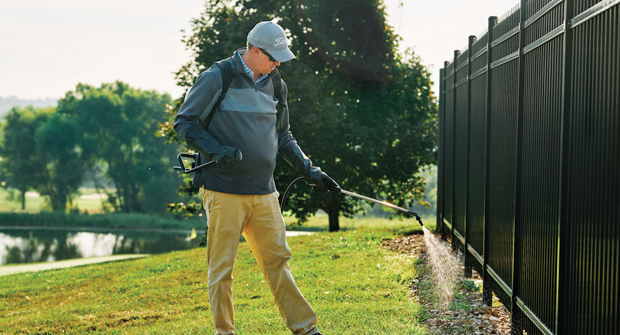
There’s no worse feeling in lawn care than making a perfect herbicide application only to see the weeds still standing. But thanks to resistance, that can sometimes be the case.
Resistance buildup is a natural process where weeds develop an ability to survive chemical treatments that previously killed them, and there are a variety of factors that can cause it to happen. Surviving plants will then reproduce, causing the next generation to also resist that treatment.
And since it’s not as obvious to diagnose compared to a common weed or pest in the yard, it’s important to prevent resistance buildup before it fights back.
Killing the ‘unkillable’
So, how do you kill a weed that blocks an herbicide? The answer isn’t as difficult as it seems, and it all starts with a smart lawn management program.
Jared Hoyle, Ph.D., field development technical scientist at PBI-Gordon, says lawn care operators (LCOs) should always be thinking about resistance when designing their application strategies.
“Rotating the modes of actions is super important. You can do that within a season. You can do that over different seasons. There’s also mixing multiple modes of actions at the same time,” Hoyle says. “And selecting products that have multiple active ingredients with different modes of actions in the same jug will also help combat it.”
Hoyle says there’s no set best practice for rotating modes of action, and operators can decide if switching it up between seasons, applications or years works best for their business. He describes it almost like an art, working to find the best option that fits the property, client and the target weed.
And as always, reading the chemical label is crucial for figuring out how to best swap out products. Jim Brosnan, Ph.D., director at the University of Tennessee Weed Diagnostics Center and a professor of turfgrass science, says understanding how herbicides work between different groups allows LCOs to know which products provide new modes of action and the best diversity.
“Know what you’re spraying,” he says. “Have an understanding that if I’m using (products) that are all Group 3 mitotic inhibitors, from a resistance management standpoint, they all work the same way.”
Do it right
Like many lawn care problems, resistance is best mitigated through best practices and good lawn care habits. For example, a strong agronomy program and healthy turf is, as Brosnan describes, “another mode of action” in the fight against resistance.
“The boring agronomy stuff might be the most important,” Brosnan says. “It should be table stakes that that’s always accounted for and optimized, but rarely is that true. And if that stuff isn’t in order, it compromises the efficacy of any spray program.”
And when just a single resistant plant has the potential to reproduce and overthrow a yard, having healthy turf with no voids to fill reduces the chance of that weed or any offspring sprouting.
Another mistake that can impact resistance deals with cost-cutting. Saving money is important for any business, but Hoyle has noticed a trend of using the lowest chemical rate possible in some applications, which rides a fine line of effectively killing the weeds. If a lethal dose isn’t used, it can in turn help build the plant’s resistance or allow it to produce an offspring that is immune.
“There’s been a trend over the years of using lower rates of products out there, and what we’re seeing is, in general, something that could be a cause of resistance when it pops up,” Hoyle says. “It’s because we’re putting sublethal doses on those plants, and those plants are then able to create a resistance to that product when, in the past, when it was done at a lethal dose, it would have killed it.”
With good spray and agronomy practices in place, diagnosing weed control issues as resistance buildup is certainly on the table. But for Brosnan, he claims that resistance can sometimes be used as a scapegoat for other turf management faults.
With the variations in weather, chemistry, environment and agronomic strategy, there are tons of variables that can cause an application to fail. LCOs should go down the checklist, making sure all steps of the application process were followed properly before rushing to diagnose a resistance problem.
“I have seen resistance kind of become a cudgel in recent years of, ‘Oh well, this is a resistance issue, so we need to blow it up and start over.’ And not every herbicide failure is that way,” Brosnan warns.
Backed by science
Brosnan’s lab focuses heavily on resistance testing and screening, and he says one of the biggest benefits of recent research is its propulsion of the topic into the mainstream. Now, there’s more of an emphasis on combating the problem through intentional management programs backed by science.
And on the product side, Hoyle says there’s now a much bigger emphasis to research new active ingredients and produce new modes of action. Plus, with new spray technology and a better understanding of certain chemistries, he says PBI-Gordon is investigating ways to utilize existing active ingredients and combine with new ones to further break resistance cycles.
All of this means that LCOs have more options than ever, and it’s important to utilize them to best tackle the problems on-site. Brosnan focuses heavily on the golf course management side of turf, and he says superintendents do a great job managing their specific courses with proactive, long-term planning.
While it’s harder to do that in the lawn care space — where sites can vary heavily in their problems and service renewals aren’t guaranteed — Brosnan argues that specifying your strategy for each lawn’s unique problems can dramatically improve the final product.
“If you look at resistance management in a golf setting, which is where the problem is probably the most key, that is really addressed through an intentional management program for that property, right?” Brosnan says. “It’s hard with the rounds-based nature of the (lawn care) business … but I do think aiming to get to that place is probably a noble goal.”