SUBSCRIBE


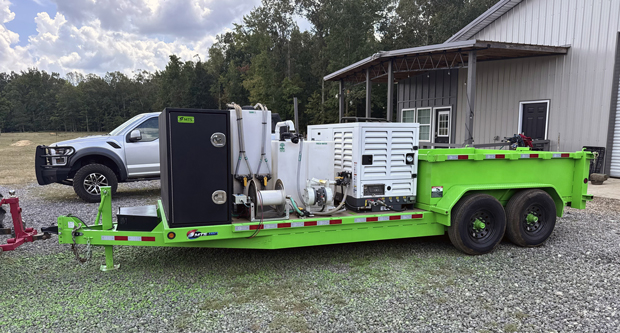
Tree care companies traditionally need multiple pieces of equipment — and potentially multiple trucks and employees — to perform a range of services involved in plant healthcare. Mobile Tree Spa is aiming to change that with a new system that brings compressed air, water, spraying capabilities, tools and material hauling together on one platform.
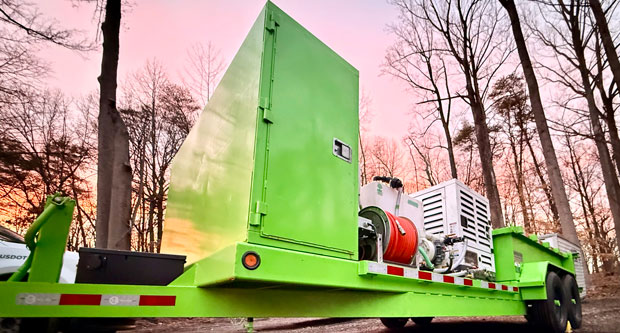
At the center of the Mobile Tree Spa MTS-180 is an ELGi 185 CFM portable air compressor powered by a Kohler diesel engine. Its compressed air powers an AirSpade used for nonmechanical soil excavation and decompaction while also powering an integrated spray system for water, organic treatments and other plant healthcare applications. The result is a single tow-behind unit designed to enable one technician to perform work that traditionally requires several pieces of equipment.
“This was really about business efficiency in the field,” said Alex Shy, president and CEO of Mobile Tree Spa. “Traditionally, you might have a separate tow-behind compressor, a spray rig taking up the bed of the truck and then another truck or trailer to haul compost and other materials. We wanted to put everything a technician needs for plant healthcare into one system.”
The concept has already produced measurable results, according to the company. Shy originally developed and tested the system through his former tree care company, Shy Tree. A single technician operating the unit helped generate approximately $50,000-$60,000 in monthly revenue while reducing the manpower and equipment required to provide those services.
Compressed air plays a particularly important role on the MTS-180 because one of its primary applications is addressing compacted soil around tree root zones.
Development, heavy equipment, foot traffic and landscaping equipment can compress soil around trees, reducing the pore space needed for water and oxygen movement. Mobile Tree Spa uses an AirSpade to direct compressed air into the ground, fracturing and loosening the soil while working around roots without mechanical excavation. Organic materials such as compost and biochar can then be incorporated into the root zone.
The application requires substantial airflow. Mobile Tree Spa can work 200 feet or more from the compressor, and Shy identified 185 CFM at 100 psi as the target needed to maintain sufficient airflow and pressure for AirSpade operation at those distances.
Compressed air also powers the MTS-180’s spray system. Mobile Tree Spa replaced the separate gas-powered pump traditionally used on spray rigs with an air-powered design, enabling the same ELGi compressor to support both soil excavation and liquid applications. Fresh water and separate tanks for organic and chemical treatments enable technicians to perform multiple services from the same platform.
Finding the right compressor for a new machine
Shy evaluated approximately five compressor brands before selecting ELGi. The compressor’s footprint, control placement, maintenance accessibility, airflow and ability to integrate into the MTS-180 all contributed to the decision.
“The design fit almost exactly what we needed,” Shy said. “The footprint, where the controls were and the accessibility for maintenance all played a part. We looked at several brands, but the ELGi checked all the boxes.”
Quiet operation is another important consideration for equipment designed to work primarily in residential and commercial landscapes. Shy said the ELGi compressor has received positive feedback during industry demonstrations because its sound level is comparatively low for the amount of compressed air it produces.
“The AirSpade itself is louder than the compressor running it,” Shy said. “For the amount of air it produces, it’s surprisingly quiet, and that matters when you’re working in residential neighborhoods.”
Fuel efficiency has also become a practical advantage. Shy said the Kohler-powered ELGi compressor can operate for approximately two to three full eight-hour service days before requiring refueling.
Mobile Tree Spa has built seven units as the system has evolved from Shy’s original prototype into its current generation. The company now operates as a manufacturer and consultant, providing tree care businesses with the equipment, hands-on training and a broader business system designed to help them establish or expand plant healthcare services.
The platform was sufficiently different from existing tree care machinery that Shy said insurance providers did not have an established classification for it when Mobile Tree Spa sought coverage and had to create one. Shy’s larger goal is to help local tree care companies transition into preventative plant healthcare using his system and equipment. By doing so, businesses can increase productivity, generate recurring revenue and protect more trees nationwide.