SUBSCRIBE


As the dog days of summer come to a close, it can feel like it’s finally time to catch a break in the lawn care industry. But as fall shows itself around the corner, so do a handful of turf problems.
Lawn care operators (LCOs) must remain vigilant, because August and early fall still provide great conditions for turf diseases to pop up and spread, including one of the most common ones: dollar spot (Clarireedia jacksonii).
It’s especially prevalent on Kentucky bluegrass, perennial ryegrass and fescues, according to Nathan Nordstedt, Ph.D., technical services manager at Quali-Pro. And as a fungal pathogen often present on thatch or infected leaf tissue, he says it can quickly make itself seen once favorable conditions are met, causing outbreaks that seemingly “appear almost overnight.”
To avoid these straw-colored patches blotting your lawns, Landscape Management asked Nordstedt his recommendations on how to predict, identify and control this costly contaminant.

Landscape Management: What environmental and weather conditions favor dollar spot infection and spread?
Nathan Nordstedt: Daytime temperatures in the upper 60s to low 80s combined with nighttime temperatures around 50-70 degrees F create ideal conditions, especially when heavy overnight dew develops.
One thing many people don’t realize is that dollar spot doesn’t require rainfall. Long periods of morning dew alone can provide enough leaf wetness for infection. That’s why we often see disease flare up in late spring and again in the fall when those environmental conditions return.
LM: How can an LCO identify dollar spot, and what other turf problems can it be mistaken for?
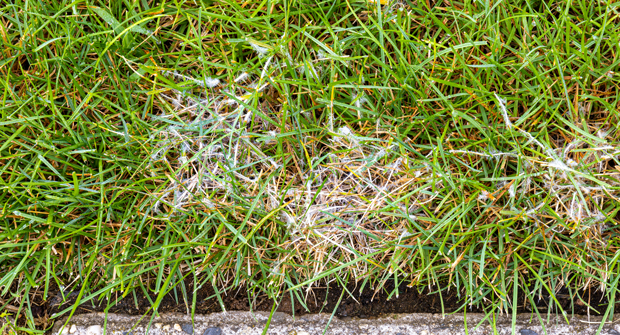
NN: If you’re able to be proactive and examine individual leaves early in development, dollar spot produces characteristic bleached lesions with reddish-brown margins. However, the first thing most LCOs notice is the small, tan to straw-colored patches scattered throughout the lawn as disease development ramps up. Early in the morning, you may also see a white, cobweb-like fungal growth on the leaf blades before the dew burns off.
Dollar spot is easy to identify once you know what you’re looking for but can sometimes be mistaken for drought stress or feeding from billbugs, chinch bugs or white grubs in the fall.
LM: What are the best control options for dollar spot, both preventatively and reactively?
NN: If dollar spot has occurred in a lawn before, preventative fungicide applications should be the standard approach. Once dollar spot becomes established in an area, the pathogen is usually present year after year. Preventative applications should begin before favorable conditions develop rather than waiting for the first spots to appear.
Fortunately, effective options include many common chemistries, including DMI and SDHI fungicides. Products with multiple modes of action, such as Strobe Pro, fit well into programs because they provide excellent control while also supporting fungicide resistance management. Rotating FRAC groups is especially important because of dollar spot’s ability to develop resistance.
One of the simplest cultural practices is maintaining adequate nitrogen fertility. Dollar spot has long been associated with nitrogen-deficient turf, so keeping the lawn actively growing can significantly reduce symptom development and aid in recovery.
Beyond fertility, irrigate deeply, less frequently and early in the morning rather than in the evening. Keep mower blades sharp and reduce long periods of leaf wetness whenever possible. Fungicides are important, but they’re most effective when they’re part of a management program.
LM: How can an LCO prepare for dollar spot outbreaks?
NN: One tool I think more LCOs should be using is the Smith-Kerns Dollar Spot Prediction Model. It uses weather data to predict when conditions are favorable for dollar spot development. Instead of relying solely on a calendar schedule, LCOs can use the model to identify when disease risk is increasing and prioritize preventative applications in areas that are most at risk.