 SUBSCRIBE


Technology can mean different things to different people.
To some, technology is something to be embraced, a personal passion that is constantly evolving and positively impacting everyday life. To others, technology is something to be tolerated, an occasionally confusing but inevitable fact of life that can both help and hurt, often at the same time. And to still others, technology is something to be feared, an obstacle that just makes things more difficult and means an end to the ways things have always been done.
You can safely count Todd Reinhart, the co-founder and co-owner of Reinhart Landscaping and Snow in Bloomington, Ill., among that first group.
“I remember in college that no one had a computer sitting on their desk. Except me,” he says with a laugh. “Everyone would be like, ‘What do you use that thing for?’ There was no wireless, the World Wide Web didn’t even really exist at that point … there was nothing. It was pretty much a glorified typewriter.”
That early passion for exploring the cutting edge has stuck with him, though, and now is front and center at the company he founded with his brother, Chad, back in 1986, which he now describes as “a technology company that happens to be in the landscape business.”
The company was one of the first to use Boss LM business software (“I think we were user No. 4,” he says) and is now an Aspire Software power user. They’ve experimented with developing their own proprietary business software, have dove headfirst into the use of battery-powered equipment and, most recently and most relevantly, have committed to the day-to-day use of autonomous mowing equipment.
“You can’t optimize this (mowing) business model any further. You can only add so many people, so many zero-turns, so much speed and efficiency per unit,” Reinhart says. “The way I see it, there’s only one way to make this business model faster and better — everything that every company in the United States does in terms of mowing. And that’s automation.”
Reinhart remains in the minority, however, with most landscape pros taking a cautious, wait-and-see attitude when it comes to autonomy. But even the most vocal skeptics will admit that the day is coming when robotic technology will be the rule rather than the exception in the green industry, whether they like it or not.
To address the questions and skepticism that many still have about autonomous mowing, Landscape Management sat down with a trio of contractors — Reinhart, Tyler Reiter with Florida Image Landscaping and Bob Ramser with American Landscaping Partners — to dive into their experiences with autonomous mowing.
We talked about their journeys into automation, the trials, tribulations and triumphs they’ve experienced along the way and why all three see autonomous mowing as not just the wave of the future but something that is already benefiting their businesses — and their bottom lines.
Todd Reinhart

Bloomington, Ill.
Many in the industry refer to Todd Reinhart as an “evangelist” when it comes to technology and automation in landscaping, and that’s a term he doesn’t shy away from. In fact, he sees it as a positive differentiator for his full-service commercial landscaping company that also does select work in high-end residential design/build.
He’s been a regular presenter on the topic at industry conferences and routinely welcomes visitors to the company’s headquarters in central Illinois to show off how crews there have embraced the use of battery-powered and autonomous equipment.

“My brother and I have both always been curious, and you can’t ever stop being curious about what’s next, how we can use it, how it can help our company,” Reinhart says. “We’ve gone to trade shows … in parallel industries to see what they’re using there and how it can be applicable in our world. What can we bring back and be first with?”
That ethos powered Reinhart Landscaping’s journey into the world of autonomous mowing, first with machines that relied on wired perimeters to operate, then with early GPS and RTK (real-time kinematic) units and now to the latest and greatest technology commercially available to landscapers.
That journey has included both smaller mowers — units Reinhart describes as “low-powered” machines that are generally left at a customer’s location and maintained by the company — as well as units with larger widths of cut that travel from jobsite to jobsite — the “high-powered” machines.
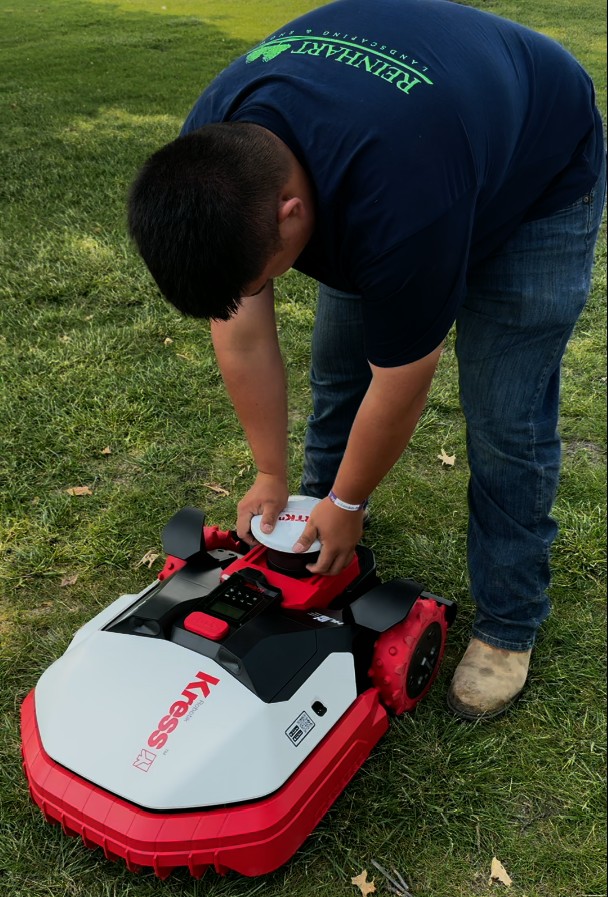
The company’s current fleet relies on mowers from both Segway Navimow and Kress, but Reinhart says his teams have used mowers from a host of other companies, too, including Husqvarna and Yarbo, the latter of which offers a snow-blowing attachment that he says is an intriguing option for a company with the word “snow” in its name.
Currently, Reinhart is deploying six high-powered units every day, each operated by a one-person crew. In addition, the company has more than 50 low-power mowers stationed at sites around the company’s service area that are monitored and maintained by a trio of team members, all recent college grads with a background in technology.
Reinhart says he and his brother take a simple approach to deciding what mowers to add to the company’s fleet: “Whatever works the best.” But don’t confuse that with the Reinharts making rash, impulsive decisions about these expensive, highly advanced machines.
“We hired a full-time data analyst about four years ago, and he’s kind of the truth-teller in the bunch. He’s using actual numbers to tell us what’s working, what’s not working and why that’s happening,” he says.
Reinhart is clear that there is often a steep learning curve when introducing autonomy into operations. He tells the story from the early days of introducing low-power mowers into the workflow, where crews would visit a site, see the mowers in their chargers, determine they hadn’t deployed properly even though they had and then manually mow the same area again, resulting in work tickets twice as large as they needed to be.
But those days are few and far between now, and Reinhart remains convinced that if the industry hasn’t already reached the tipping point with the use of autonomous mowers, it’s getting very, very close.
“We’ve already had our ‘aha!’ moment with autonomy. Now, we’re seeing the effects of that decision where we have an existing workforce with a new set of skills, or we’re attracting a different kind of workforce when we’re hiring,” Reinhart says. “We’re not looking for people to mow grass; we’re looking for people to deploy a fleet of robotic mowers.
“The customers notice, too. The people that we’ve converted to autonomous will never go back. When renewals come up, they’re insisting in the contracts that we’ll only use autonomous on their property. It’s becoming a competitive advantage, and I think around the country, you’re going to start seeing pockets pop up and then, suddenly, it’s going to explode.”
Tyler Reiter
West Palm Beach, Fla.
Tyler Reiter’s first recollection of autonomous mowers came during the 2017 GIE+Expo (now Equip Exposition) in Louisville, Ky. He was wandering the trade show floor with his father, Scott, when they passed by the Husqvarna booth.
“I remember seeing them in the booth and telling my dad, half-joking, that they were a Roomba for your lawn,” says Reiter, who shares ownership of Florida Image Landscaping with his father and serves as its director of operations. “But it didn’t take me long to realize how much sense something like that made and that we were going to need to figure it all out and understand it.
“You knew that with the direction things were going, it was not a matter of ‘if,’ but a matter of ‘when.’”
It was an encounter that opened a rabbit hole for Reiter and Florida Image Landscaping that he’s never really climbed out of. From early experiments with wired units (“a nightmare,” he says now) to now testing units for a wide range of manufacturers, Reiter has become one of the industry’s preeminent purveyors of robotic mowers.
He’s even started a second company, Mowtek, that sells and services autonomous mowers to residential and commercial clients alike.
Specific to his work with the landscaping company originally founded by his father, though, Reiter and the team at Florida Image Landscaping have largely focused their efforts on smaller, stationary units from Kress and Segway Navimow that are left at the properties they service, mainly residential and HOA customers (although Reiter expresses a fascination with the new Kress KR800 Voyager, a commercial zero-turn unit with a 40-inch width of cut).
“What’s working for us is using stationary mowers wherever we can, and where we can’t, using the cut-and-go style mowers,” he says. “My goal is to have 80 percent of all my accounts be completely robotically mowed by the end of this year.”
Reiter cites notable savings in time and labor as the prime benefits realized from the shift to autonomy, benefits often noted by proponents of the technology. Those are especially important in a market like South Florida, where heat and plentiful rainfall mean a non-stop mowing cycle in season.
“With robotics, I can have stationary mowers on property, deploying a minimum of three times a week and having them cut grass enough that it keeps up with growth,” he explains. “Then, the only thing my guys do is string trim, edge, blow, focus on enhancements, the annuals, mulching. It’s allowed us to consolidate a crew from a traditional three-to-five-person crew down to two or three.”
Reiter admits the technology itself can be intimidating, but trial and error and a willingness to keep trying have paid dividends at Florida Image Landscaping. “I’m not a tech guy … at all. I barely graduated high school,” he says. “But I like to fail forward. They would just tell me how to do it, and then I would push it to keep seeing how far these things could go.”
And at the end of the day, leaning back into the thing that revealed autonomous mowing to him in the first place — industry events, conferences and trade shows — helped him learn and to write a new chapter for his company.
“I’m such a proponent of going to events, networking and just getting educated. When people meet and share information, it only helps enable, promote and grow the industry,” Reiter says. “That’s why events like Equip are massive. My dad and I going there and spending just 10 minutes at the Husqvarna booth changed the entire trajectory of how we run and operate our company.”
Bob Ramser
Brentwood, Tenn.
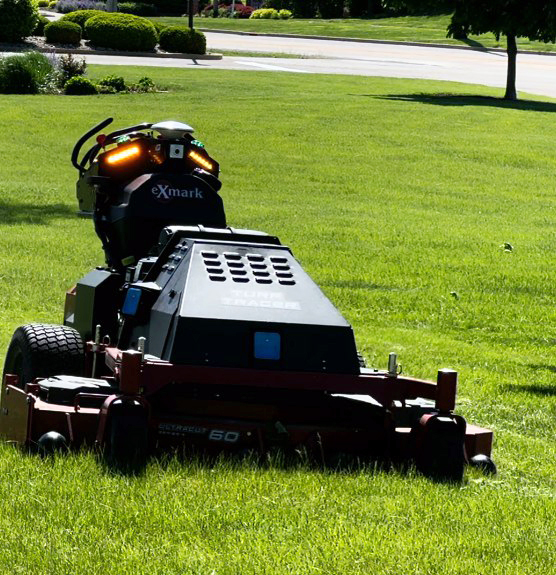
Unlike Reinhart and Reiter, Ramser and American Landscaping Partners have fully committed their autonomous efforts to larger, stand-on units, specifically the M.52 from Scythe Robotics.
It’s a decision that makes perfect sense considering that the private-equity-backed company and its 11 locations spread across six states do a steady business with schools and universities, work that often includes the maintenance and preparation of sports fields.
Their guinea pig for autonomy was John Carroll University in University Heights, Ohio, just outside of Cleveland.
“We were maintaining all the fields at John Carroll University for five or six years … and we were running into issues,” says Ramser, the vice president of operations for American Landscaping Partners. “In the spring, softball and baseball were playing at the same time, and I had a one-person on-site crew. He would groom one field one day — mow, line the field, do all the prep for a game — then he’d have to do it all over again the next day on the other field. It was just dragging us down.”
Ramser says that automation was an “eye-opener” as a potential solution to that problem. After first experimenting with traditional mowers from Wright Manufacturing that had been retrofitted with technology from Greenzie to give them autonomous capabilities, the team at Scythe came calling with the M.52, a stand-on, 52-inch unit that had been purpose-built for commercial landscaping.
“They were a little further along than other options with the technology, the mapping, the dashboards that they have,” Ramser says. “We started with two units there and immediately fell in love with it. In my eyes, it was the perfect fit for that technology and the application that we wanted to use them in — wide-open fields, nothing in their way. Just start them up and let them go.”
Now, American Landscaping Partners has 25 Scythe mowers in regular use across Ohio, Tennessee and Alabama. In these primarily campus settings, Ramser says that automation has offered significant savings in time, including one instance where sports field prep was cut from six hours to two with the introduction of autonomy.
“It’s not like we’re just the grounds crew for the sports fields on these campuses, either,” Ramser explains. “We’re mowing other areas of the campus, planting flowers and managing irrigation. We help set up for commencement, hang banners and put up Christmas lights. Our guys have really embraced how much more they’re able to do in other areas with these mowers doing their thing.”
Ramser says American Landscaping Partners hasn’t yet taken the M.52s into residential settings aside from select, one-off opportunities. He also says that employee buy-in and optimizing crew routing have been challenges that he and the company have tackled since introducing autonomous mowing into their day-to-day operations.
“A lot of the guys liked being on the mower and cutting those open fields. It was their favorite part of the job, and we’ve taken that away and asked them to focus more on the detail side of the job. That’s been an adjustment,” Ramser says.
“The second challenge … is the routing. If you haven’t identified the perfect candidates for these mowers and you’re having to hop around more, and your drive times increase, that creates problems. You really have to make sure you have crews where they need to be, with existing customers, then try to market and sell (autonomy) around that to take advantage of those routes.”
Still, Ramser says the good has far outweighed the bad in terms of his company’s introduction of autonomy, and he’s eager to see what’s next from industry manufacturers and how those new tools can help his teams.
“As long as you have the accounts and applications to support it, and you do your homework regarding route density and planning, this technology definitely has a place in our industry,” Ramser says. “It’s easy to fall in love with the technology, but you have to be intentional and able to utilize it efficiently. We’ve been able to do that in most instances, and it’s really helped our operations.”