SUBSCRIBE


This summer, the whole world came together to watch the beautiful game at the FIFA World Cup, where Spain knocked off Argentina to lift the trophy for the second time in the nation’s history.
It’s the game that unites us all — even non-soccer fans can get caught up in the hype of the biggest sporting event in the world — and that’s why it was chosen as the theme of this year’s Early Order Program Guide.
Because now that the hype of the tournament is dying down, the pressures of buying for next year and making budgets only grows, and early order programs (EOPs) are one winning tactic that can also unite the industry.
Head in the game
The EOP Guide is a feature that Landscape Management’s sister publication, Golfdom, also runs in the fall. And with a longer history in the golf course management space and more adoption by superintendents, the big question remains: Why don’t lawn care operators (LCOs) use EOPs to the same degree?
EOPs are simply newer to the lawn care space, and thanks to the varying acreage and number of clients landscapers face each year, it’s harder for LCOs to know how much of a product they’ll need to buy early.
Plus, EOPs simply aren’t a fit for every lawn care operation. Small companies can get away with buying products as needed, and some operators with all-year growing seasons might choose to continually buy in bulk outside of just EOP season.
But that still leaves most operations eligible to score some big savings each fall and winter through EOPs, and to rally the industry together, LM asked three expert operators to explain why EOPs are a strategic win for lawn pros.
Preseason prep
When buying for the next year, the biggest opponent for lawn pros is not knowing how much product they’ll need. EOPs offer larger discounts when LCOs buy more and bundle products together, but if those purchases sit on the shelf and go unused, those savings turn into wasted spending.
That’s why it’s critical to understand and log your agronomy program, according to Josh Stewart, owner of Lawn Doctor of Baldwin and Mobile Counties in Alabama.
“We have a CRM where all of our information is housed, and we’ve got a pretty good idea of what our total square footage is per round. We know what products we buy for each round, and we just go in there and update the size, and you plug in the square footage, and you define the program, and we know probably within 5-10 percent (error) that we’re going to buy certain products,” Stewart says. “It starts with having a defined program and not just saying, ‘Well, what am I going to do next month?’ If you’re going to run your business like that, it’s not going to work.”
Keeping track of past years and how much product is used is also crucial to help with acreage forecasts. Dan Turner, owner of Custom Lawns outside of Cleveland, Ohio, started using EOPs on his herbicides for the first time last fall, but thanks to his data that spanned multiple years, he said it was a smooth process.
“We looked at what (products) we’ve used over the years and the amount of product we’ve used in each one and calculated how much total we need to make it through a year with everything,” Turner says. “When you know you’re going to use that amount of product, and you see you’re going to be able to save a good amount of money, it kind of was a no-brainer for us to go ahead and pull the trigger this year on doing something like that.”
Kickoff
Outside of savings, EOPs also come with a handful of other benefits catered to the lawn care industry. To complement the early orders, buyers can also get early deliveries on their purchases.
“During COVID, we had issues with getting material. If you buy in an EOP, you’re pretty much guaranteed that material because you’re going to get it first because you’re locking it up in October,” Stewart says. “You don’t run into as many supply chain issues.”
But one issue that comes with buying for the full year is that all those chemicals and products need to be stored somewhere. Jason James, owner of Turf212 in South Carolina, says not everyone has a big warehouse to store every product, and if they did, it still could cause problems.
James recommends investing in companies that can ship what you need to start the season and then store the rest in their own facilities. From there, the distributor can deliver more products as needed.
“I call them and say, ‘Can you bring me another tote of herbicide next week?’ Then, they’ll schedule that delivery and bring it to me next week, and it’s already paid for,” James says. “If I had $300,000 of the product in my warehouse, that’s $300,000 worth of money just sitting on my floor that could easily grow legs and walk away.”
A late winner
Especially in the lawn care space compared to golf course maintenance, cash flow is one of the biggest issues that can block an LCO from engaging in EOPs. Thankfully, many programs offer late payment terms, allowing buyers to order all their products in the fall and winter — when they’re not getting as many new clients — and not have to pay for them until the early summer.
This model gives LCOs some time to figure out their total acreage, returning clients and new customers fitting into their program. And once that program starts running in the spring, LCOs can get some extra money in the bank to help pay for the upcoming summer bill.
James says these late-payment terms can be crucial, allowing operators to start the year on someone else’s dollar while investing in other parts of the business. But he also warns that the bill will always be around the corner, so he recommends doing smaller, monthly payments in the meantime to chip away at the total.
“My advice is to set aside monthly payments. If I’ve got a $100,000 EOP bill … set aside $10,000 a month and pay a monthly installment on that payment, because you don’t want to wait until the last month to pay for it,” James says. “Because if not, once you get to June, now you’ve got to figure out how to come up with $100,000.”
To start saving money early, or if late payment isn’t the best model to fit the business, Stewart recommends investing heavily in a prepay offering for clients. He says come November, he sends messages to customers offering a 5-percent discount if they renew with him for the next year, which helps get some extra cash in the bank before many EOP deadlines.
“I’ll collect $100,000 by Jan. 1, and it’s for that purpose,” Stewart says. “That allows me to pay for that material now and get it at a discount.”
Lifting the trophy
With all these chemical manufacturers offering slightly different terms, benefits and rebates, how can you tell which program is your biggest winner?
An important first step is to talk to other turf pros, sales representatives and trusted partners about the turf challenges facing your business, the most effective control methods and the products that can get the job done. Once a solid agronomy program has been laid out, it’s time to pick the EOPs that fit in seamlessly and yield the most rewards.
“As you’re going, you start talking to people with similar turf types and finding out what works well for them. And you share that information, and you try different things as you go, and you know what works really well, and you know what not to do next year,” Stewart says. “It’s a constant process of refining.”
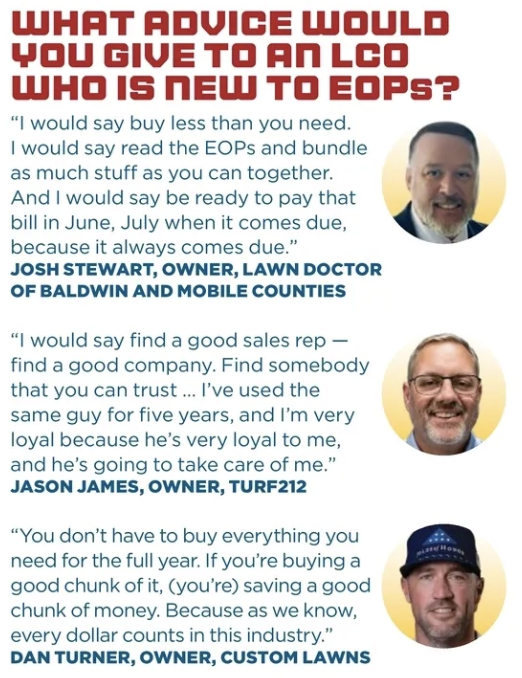
Once target products, modes of action and everything in between have been identified, James says sitting down with sales reps from larger manufacturers is important to get their best recommendations on how to save money.
“It all comes back to who your representative is,” he says. “They can say, ‘Hey, sometimes it’s better to use an EOP on this product, but you (shouldn’t use) an EOP on this product because they’re giving it to you cheaper, anyways.’”
Once EOP season is over, these experts say the money saved provides a great opportunity to invest back in the business. Turner, for example, says his first year of EOPs helped reach his goals of removing a surcharge on gas, giving raises to the team and buying new push spreaders. Stewart says the money can also be used on things like advertising and employee training.
“Result-wise, (EOPs were) everything we’ve expected and more,” Turner says. “Knowing you have the products needed — not having to worry about getting a delivery or running up to one of the wholesalers and picking up the product — is less stress on us in the office, just knowing we have everything needed.”