 SUBSCRIBE


Maximizing jobsite productivity is a constant topic of interest. However, the real bottlenecks often occur during the morning rollout and late-afternoon return. To tighten these daily transitions, seasoned industry pros share their methods for optimizing yard logistics and streamlining equipment maintenance.
Start at the end
Many crews waste morning minutes on recurring tasks that should have been addressed the prior afternoon. So, Bob Marks, president of EMI Landscape in Macungie, Pa., treats the end-of-day transition as a disciplined ritual.
EMI crews follow a synchronized procedure upon returning to base. According to Marks, after refueling, each crew performs a 20-minute “truck reset,” unloading every machine, checking fluids and parts and installing sharpened blades. This ensures equipment is ready for a seamless departure the next morning.
“Every night, basically, the maintenance trucks are ready to go when (crews) leave,” Marks says.
This procedure reduces callbacks while helping Marks manage indirect time, those non-billable, unproductive hours that erode profit margins.
“The efficiency of having this routine done every day, while it is indirect time, it eliminates so much other indirect time that’s harder to track,” Marks says.
Put a stop to stops
To smooth out inefficiencies, many contractors adopt fleet and equipment standardization to create predictability. Ted Glaser, CEO of Lincoln, Neb.-based Summit Lawns, anchors his business in simplicity, using Chick-fil-A’s high-output business model as a blueprint.
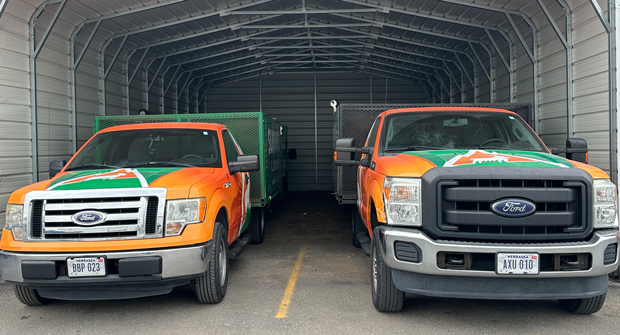
For example, Glaser has nearly eliminated landscape trailers, instead investing in custom-built Ford F-150s that remain loaded 24/7 under protective carports. This shields equipment during the off hours from the elements, while a strategic interlocking parking pattern thwarts theft.
Summit Lawns also eliminated the morning detour to gas stations and convenience stores. On-site fueling and a fully stocked pantry remove the need for crews to navigate these retail bottlenecks, allowing crews to beat morning rush hour.
“If our guys leave the yard and immediately go to the gas station, they get stuck in line between every other contractor in the city,” Glaser says. “Now, our guys clock in, grab their food, their breakfast, and they’re out the door in 10 minutes.”
Clear a path
Operational efficiency also relies on minimizing physical movements. Too often, poor facility layout forces crews into time-consuming “touches,” a term Andy Hawley, branch manager at Watsonville, Calif.-based K&D Landscaping, uses to describe repeated loading and unloading of gear.
“Crews must have a lane of travel that moves around the yard as best as possible,” Hawley says. “You want to consider the most logical flow that reduces the steps it takes to get from the trailer to the equipment and then get the equipment back to the trailer.”
To eliminate yard congestion, Ryan McCarthy, president and CEO of Waukee, Iowa-based RJ Lawn and Landscape, staggers departures in 30-minute waves. Mowing and application teams leave at 7 a.m., followed by landscaping crews at 7:30 a.m.
“I used to say our goal was in and out in eight (minutes),” he says. “Now, that’s more like 10 to 15 minutes, and if I can get half the company out of here in 15 minutes and then have the next wave come in, well, I can live with that.”
Buy-in and accountability
Crew buy-in is another catalyst for efficiency. Greg Witcomb, branch manager of Gold Coast Landscape Services in Lake Worth, Fla., uses a “slow-burn” strategy when optimizing operational logistics. Witcomb notes bombarding crews with sudden changes is counterproductive.
“You need crews to buy in and see that these things that you’re changing and restricting are working, and working in their favor,” he says of gaining acceptance of new operational models. “Your labor force must see the benefit from doing these things. That’s the key.”
Transitioning a workforce to new routines is a daunting task, but Witcomb says the secret lies in identifying internal influencers.
“If you get the buy-in from the ground-level leaders, then they’re going to get everyone else to follow suit,” he says.