 SUBSCRIBE



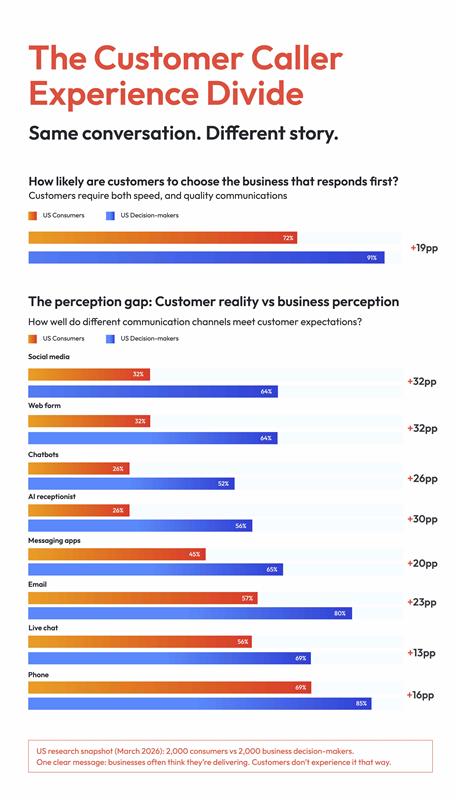
A new report from Moneypenny, a customer-conversations company, shows businesses believe they are delivering a better call experience than their customers perceive. The research was commissioned among 2,000 businesses and 2,000 consumers to understand the gap between business and customer perceptions, and across every contact method tested, businesses scored themselves significantly higher than customers.
Crucially, the research also suggests that when service falls short, customers are unlikely to complain, instead choosing to go elsewhere, creating a hidden and often unmeasured revenue risk for businesses.
“Across each channel, there were significant gaps between how businesses graded themselves versus their customers – some as high as 32 percentage points,” said Jesper With-Fogstrup, group CEO for Moneypenny. “The survey also revealed that the channels businesses rely on the most to drive sales conversions are often those that fall short in terms of meeting customer expectations, highlighting a critical disconnect.”
For example, 64 percent of businesses surveyed said their social media drives conversion, but only 32 percent of consumers felt it meets expectations. Company web forms show a similar perception gap, with 64 percent of businesses believing they drive conversion but only 32 percent of consumers feeling they meet expectations. The pattern was repeated for company AI receptionists: 56 percent (business belief) versus 26 percent (consumer perception) and for chatbots: 54 percent versus 26 percent, respectively. Messaging apps had a 20-percentage point difference, email a 23-percentage point difference, while Live Chat had a gap of 13 and phone a gap of 16.
Speed is now decisive, with 70 percent of consumers choosing the business that responds first, turning slow response into immediate lost revenue. A whopping 89 percent of businesses said the phone was effective at converting customer inquiries into actual business, more than any other channel, and 69 percent of consumers agreed. Further aligning on the need for calls to be answered as quickly as possible: 33 percent of businesses and 17 percent of consumers think a response should be within seconds, while 36 percent of businesses and 41 percent of consumers think within minutes.
Speed of response is key in a world where consumers order dinner, book taxis and stream films on demand. They don’t wait around for a call back, and will simply choose the business that responds fastest, with the Moneypenny survey showing that 72 percent of consumers say they are likely to choose the business that responds first.
When considering factors that determine loyalty to a company, speed of response (36 percent) and “quality I can rely on” (32 percent) rank more highly with consumers than trusting the brand (30 percent). The findings also highlight how little feedback businesses receive when things go wrong, with customers far more likely to abandon an inquiry entirely than raise a complaint, reinforcing how easily missed interactions can translate into lost revenue.
When asked what matters most on first contact, both businesses and consumers rated clarity, professionalism and courtesy as most important, but there was a significant perception gap in the importance of personalization, with 87 percent of businesses rating it as important, compared with only 65 percent of consumers.
The survey showed that 39 percent of consumers say call support between 9 a.m. and 5 p.m. would best meet their needs, while 24 percent would prefer early evening support between 5 p.m. and 9 p.m. This suggests many businesses may be missing a key window of customer intent outside traditional working hours, particularly in the early evening when demand remains high.
According to the research, this after-hours availability makes customers more likely to feel reassured (37 percent), choose or stick with a business (32 percent), make the company stand out compared to others (31 percent) and complete an inquiry or purchase (31 percent). Businesses (40 percent) recognize that customers expect after-hours support, and yet, most of those surveyed cite staffing and cost as the reason they do not extend coverage.