 SUBSCRIBE


Landscape maintenance operations vary drastically. Fleet configurations range from open to enclosed trailers, with some crews utilizing walk-behind mowers and handheld equipment, and others relying on large stand-on or ride-on zero-turn mowers. So, a one-size-fits-all approach fails to serve today’s professional contractors.
As a result, the foremost question for professional contractors revolves around daily power capacity and whether a battery-powered fleet can meet the demands of a full day of mowing and maintenance. In fact, it’s enough to generate a fair amount of “runtime anxiety” when weighing a conversion from traditional gas to a battery-powered fleet.
Greenworks Commercial has spent the better part of the last decade refining its approach to battery-powered, professional-grade commercial mowers and handheld equipment with its Optimus series. And company engineers recognized early on that the primary barrier to adoption for professional landscapers was not the initial equipment investment but rather the need for seamless runtime.
Greenworks met this conundrum head-on by developing the ChargeLink system, a reliable, highly versatile, modular suite of distinct charging solutions designed to provide uninterrupted daytime operation and seamless overnight charging, outperforming traditional gas-powered setups, says Corey Fisher, director of vehicle engineering, Greenworks North America.
“Battery-powered equipment has been our bread and butter since we started, and we understand the customer’s concerns about range anxiety better than anyone,” Fisher says. “So, we’ve been aggressive in solving these issues.”
To power maintenance teams in the field, Greenworks designed the 82V Optimus ChargeLink Six-Port Caddy, a rugged, mobile battery storage and charging station. It eliminates the need to haul multiple individual batteries around a jobsite, Fisher says.
Besides being a standalone charger, Fisher says the caddy integrates seamlessly with the Greenworks OptimusZ zero-turn mowers and the ETO (Electronic Take-Off) system. When mounted to the machine via the ETO plate, it functions as an auxiliary mobile charging station, providing power to run handheld landscape tools in the field.
By converting a mower’s massive onboard power source into a mobile distribution hub, Fisher says Greenworks ensures contractors can maintain continuous, uninterrupted runtime precisely where and when a maintenance crew needs it most.
“Greenworks’ (zero-turn mowers) have more than enough power to last all day,” Fisher says. “Now they can pick up a handheld battery from one of these guys, put it on and start charging, and hand them immediately another battery that’s sitting in this six-port caddy. So, he’s got six in there ready to go. As he sees a guy that’s getting low (on power) or gets flagged over, he pulls a fresh battery out, hands it to him, grabs that used battery, and plugs it in. Depending on the battery size, in 20 minutes to an hour, that battery is fully charged. Now you can hand that off to someone else.”
Additionally, Greenworks battery-powered infrastructure resolves common in-the-field operational inefficiencies. Unlike traditional gas equipment, which forces a crew member to halt production and walk a significant distance back to a truck or trailer for a refill, the Greenworks system maximizes on-the-job efficiency and keeps crews moving forward without disruption.
“On a maintenance crew, one guy is mowing, another guy is trimming, and one guy is blowing or trimming the hedges. If a piece of equipment runs out of fuel, they typically have to walk back to the truck or trailer to refuel. Depending on the site, that could take 10 to 20 minutes,” says Nick Jiannas, vice president, commercial sales, Greenworks North America.
“Now, if a battery dies, all that worker needs to do is open up the caddy, put the used battery in there, and grab a fresh one. Now, he’s right back to work, and the crew stays together.”
Secondary to daily in-the-field runtime is the logistical challenge of overnight charging, specifically how landscape pros can replenish multiple high-capacity batteries simultaneously without overloading standard electrical breakers.
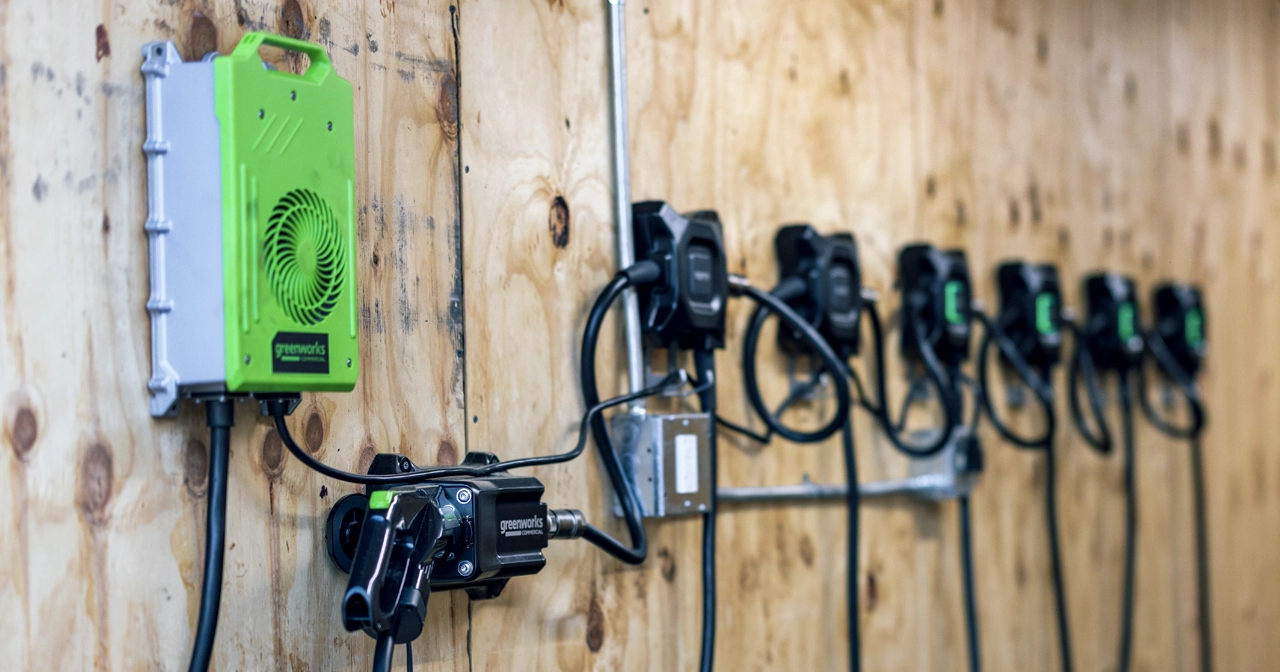
Greenworks’ answer is the ChargeLink Shop Charger, a modular, multi-bay charging station that can charge up to 60 batteries overnight from a single standard wall outlet, enabling highly scalable overnight fleet management.
Initially, some contractors may be leery of the immense power required to charge multiple high-capacity batteries simultaneously on traditional electrical infrastructure. While a brand-new, specialized facility might have the luxury of custom, heavy-duty circuits wired for simultaneous charging, the vast majority of contractors face strict infrastructure limitations. Fisher says high-powered chargers can pull nearly 15 amps for every two batteries to achieve a rapid, sub-one-hour charge, meaning a full fleet plugged in at once has the potential to overload the system and trip circuit breakers.
“That’s an unpleasant surprise when you show up the next morning, and none of the batteries have been charged,” Fisher says.
Greenworks’ ChargeLink Shop Charger mitigates this risk by serving as an intelligent energy management hub that stages the charging process and limits the current draw.
Instead of a massive, simultaneous power surge, the system sequences the charging cycles throughout the night, Fisher says. Because crews typically return to the shop between 4 p.m. and 6 p.m. and do not head back out until 6 a.m. the following morning, Fisher says the system capitalizes on that 12-hour window to sequentially restore the entire fleet.
“Contractors can scale the system by adding as many units as their fleet requires, relying on the system to safely balance the power load, protect the building’s infrastructure, and guarantee that every battery is fully charged and ready for operation by morning,” he says. “The technology just handles it all and lets contractors sleep comfortably at night, knowing power is going to be there in the morning and the batteries are going to be charged.”