 SUBSCRIBE


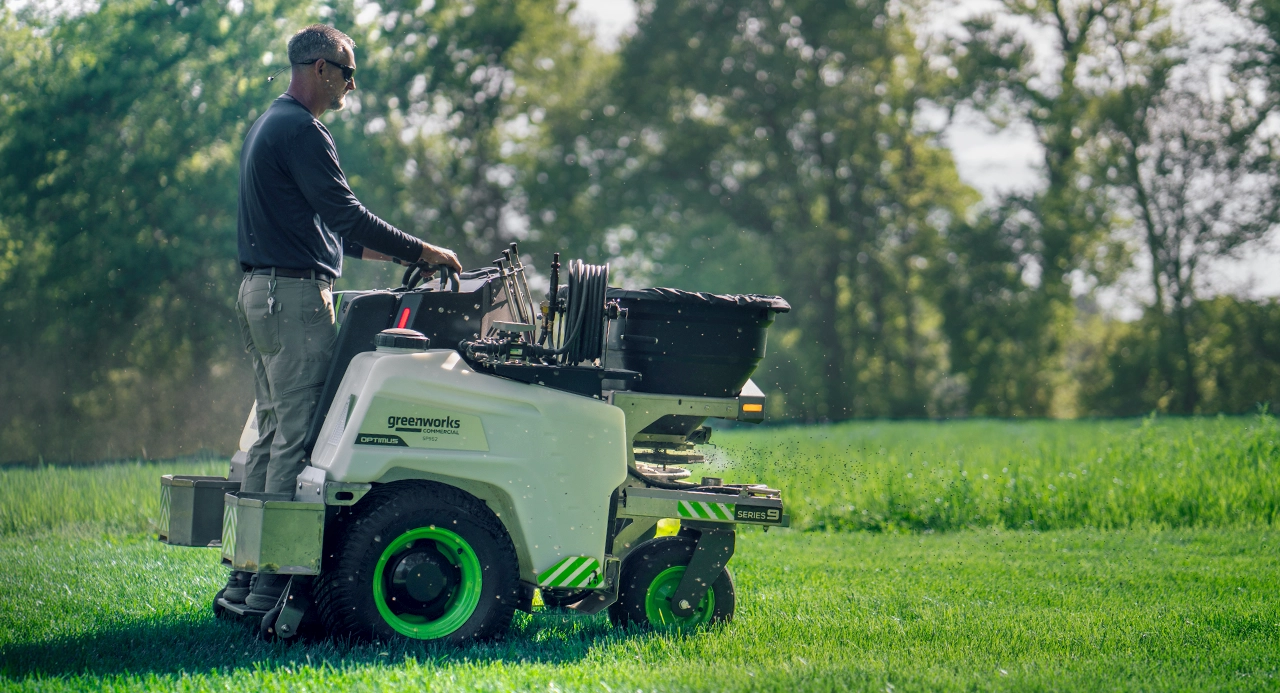
While it may not be an everyday tool for the average landscape crew, the value of the Greenworks Series 9 52-inch battery-powered spreader-sprayer cannot be overlooked or undervalued.
A recent addition to the Optimus line of commercial battery-powered equipment, this heavy-duty unit is the industry’s first battery-powered, stand-on, zero-turn spreader-sprayer. It features an 8-kW, 82-volt battery system with dual 5-kW wheel motors. These power a 60-gallon liquid tank capacity and a 10-foot spray reach, while the dry hopper holds up to 220 pounds.
The spreader-sprayer’s development was driven largely by direct feedback from professional contractors seeking a more reliable alternative to gas-powered units, which are often difficult to maintain and unpredictable, says Corey Fisher, Greenworks’ director of vehicle engineering. By eliminating the internal combustion engine, Greenworks removes nearly 70% of the maintenance issues and mechanical failures associated with stand-on spreader-sprayers, he says.
“When you’re spraying and spreading, the chemicals corrode a lot of different components, and the industry, by and large, has made it easy to replace and service spray nozzles and tubes,” Fisher says. “But the two service items you can not get away from are the gas engine and the hydraulic transmission. Those two things cost upwards of $1,000 per year in maintenance. So, eliminating those service items was our number one goal.”
Because the spreader-sprayer is typically a spring and fall tool, a machine may go months between uses, leading to maintenance issues. Fisher explains that gasoline is in a constant state of degradation, regardless of whether stabilizers are used. Over several months, fuel remaining in a unit will accumulate moisture, fouling fuel lines and filters and creating a maintenance burden that contractors have come to expect after a period of dormancy.
“As long as [the battery-powered unit] is kept in a normal-temperature environment of a garage and shed with a reasonable charge, they’re ready to go,” he says, adding that Greenworks’ high-capacity batteries lose only 1% to 2% of their charge per month.
Beyond maintenance, the drive speed and controls of the Greenworks battery-powered spreader-sprayer introduce a level of precision and efficiency previously unattainable with gas engines. Unlike traditional units that rely on inconsistent RPM adjustments and operator guesswork to maintain speed, Greenworks’ electric motor allows for speed settings accurate to within a tenth of a mile per hour.
This level of precision is critical when applying fertilizer or a pesticide, where speed directly dictates the accuracy of material distribution, Fisher says.
“With mowing, it doesn’t matter if you’re going six miles an hour or eight miles an hour because you’re just trying to be productive,” he says. “With a sprayer-spreader, speed is accuracy because if you over-distribute [material], you’re going to have issues. Either you’re wasting money by putting too much product down, or you’re killing grass by putting too much chemicals on it.”
The Greenworks spreader-sprayer platform offers simplicity and precision by removing the need for operator expertise. The machine features four preset speeds to ensure it drives at an exact, repeatable pace every time, Fisher says. This is key for work requiring frequent stops. With a gas unit, an operator must engage the parking brake and throttle down before dismounting. Upon returning, they must throttle the unit back up while attempting to guess the correct RPM for consistent application.
“That could be off by 5% to 25% every single time [the operator] does that, and that could be five times an hour, ten times an hour or more depending on the project,” he says. “With the Greenworkers spreader/sprayer’s operator presence controls and simple parking switch, the operator gets off to grab something and gets back on, that unit is ready to go again. You don’t have to change anything.”
Additionally, Greenworks’ spreader-sprayer platform addresses landscape professionals’ dilemma of labor shortages and high turnover rates, especially for a tool used in the spring and fall.
“Often, the guy the contractor hired in the spring may not be the one running the spreader-sprayer in the fall,” he says. “Greenworks has made a machine that the contractor doesn’t have to teach an operator how to adjust and dial in the application. Instead, you put in the speed and the flow rate, and it works every time. That’s the precision that the landscape professional needs.”
Greenworks’ spreader-sprayer’s remarkable energy efficiency addresses the industry’s pervasive issue of range anxiety. Fisher explains that while electric mowers consume roughly 80% of their power for blade rotation, the spreader-sprayer lacks such high-energy draws.
“In a single charge, Greenworks’ spreader-sprayer is doing right around 25 to 35 acres of spraying and up to 40 acres of spreading,” he says. “That’s a lot of distance, and more than most commercial crews are going to do in a day or a week.”
Greenworks engineering philosophy centers on the intersection of productivity, intelligence, and simplicity. By prioritizing these three pillars, Fisher says Greenworks eliminates the marginal time losses that add up to significant productivity drain for professional landscape contractors.
“Eliminating the pain points for the operator, for the maintenance and service, and for the use is what we’re all about,” he says. “We want to deliver that productivity through that simplicity and that intelligence with our products. That’s something we’re really proud of.”