 SUBSCRIBE


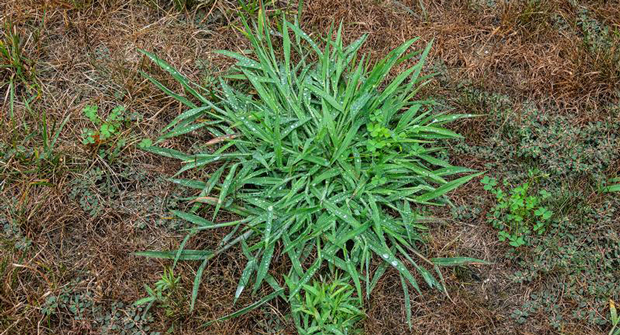
For these annual weeds, it’s all about timing.
Crabgrass (Digitaria spp.) and goosegrass (Eleusine indica) often get lumped together in the turfgrass world for a few reasons, but the biggest being how they’re controlled.
“The biggest (comparison) is if you get your preemergent timed correctly, you have good control on both,” says Jay Wyrick, agronomist for FineTurf in North Carolina.
These grassy warm-season annuals also both prefer thin, compact soil and hotter spots in the lawn, as well as the fact that they crowd out favorable turf with low-growing, seed-producing mats that can be tough to control once established.

Wyrick recommends paying attention to soil temperatures to know when that first round of preemergent herbicide should go down. He says crabgrass starts germinating when it hits 55 degrees F for a few days, and goosegrass will usually do the same a few weeks later as soil temperatures hit 65.
“When you start seeing that 50-, 51-degree range, you probably ought to be getting your preemergent down,” Wyrick says. “You have to think along the edges of concrete, asphalt, those surfaces are heating up quicker and faster due to radiant heat … That’s where you’re going to see it first, and that’s also where your preemergents are going to tend to fail first.”
For Wyrick and his part of the Transition Zone, that means he’ll wrap up a first round of preemergents by mid-February, followed by a second wave roughly six weeks later that will hopefully be done by early April. After that, FineTurf will switch to postemergents, which Wyrick says are less effective in general.
“Once they get into the June timeframe, honestly, they’re hard to control,” he says. “It’s almost like a teenager with raging hormones — very easy to control early on and fairly easy to control late in the summer, but mid-summer, it’s pretty difficult to get really good control on either one of them.”
Pick the product
Wyrick says the crabgrass/goosegrass applications are one of the most important for the calendar year, especially as goosegrass continues to grow more prevalent in his area, so it’s important to get it right with the best products.
“We rely heavily on prodiamine,” he recommends for the preemergent.
He also says dithiopyr is an effective option, as FineTurf had to switch it up and use that as well in response to some late freezing temperatures that hit his area.
Postemergent control is more specific, and Wyrick warns that matching the right product to the type of warm- or cool-season turf being infested is a much bigger issue compared to preemergent controls.
“That’s why preemergents are so important to get that early control, because postemergent can become very expensive and time consuming — labor intensive, too,” Wyrick says.
Know the difference
When spraying for crabgrass and goosegrass after they’ve sprouted, it’s important to make sure the right weed is being identified. For example, Wyrick says that crabgrass can often be confused with dallisgrass, and other grassy weeds can sometimes make a case for themselves to the untrained eye.
Crabgrass is lighter green in color and clumpier than its goose counterpart, with wider leaves that grow out in a star shape. Wyrick says goosegrass has a whiter center in the “eye” of the plant, and many pros describe it as similar to a wagon wheel with darker green leaves spreading outward.
And if you do need to search for them, Wyrick recommends starting in hotter areas along sidewalks, driveways and paths.