 SUBSCRIBE


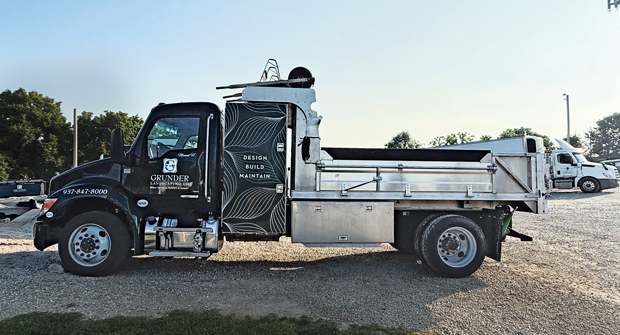
Partner and creative director Emily Fleniken of Lemon Seed Marketing shares why vehicle wraps are one of the most powerful branding tools for landscaping companies and offers practical design tips to turn everyday fleets into memorable rolling billboards.
Why are vehicle wraps such an effective branding tool for service-based businesses like landscaping companies?
Vehicle wraps are one of the most powerful branding tools a service company can invest in because they put your brand directly into the neighborhoods you want to work in. Every time a truck pulls into a driveway, sits at a red light, or drives through a subdivision, it becomes a moving billboard.
For service-based businesses like landscaping companies, that visibility is incredibly valuable because your ideal customer is literally watching you work in their neighborhood. A well-designed wrap builds familiarity and trust over time. People start recognizing the trucks, associating them with quality work, and when they need landscaping services, the company they’ve seen around town is the first one that comes to mind.
From a branding standpoint, what separates a truck wrap that actually builds brand recognition from one that just lists a company name and phone number?
The difference is memorability.
Many wraps simply list the company name, phone number, and a few services. That’s not branding — that’s just information. Real branding creates something people remember even after the truck is gone.
A wrap that builds brand recognition usually has a strong visual identity: bold colors, a clear logo, a simple message, and often a unique element like a mascot, character, pattern, or tagline. The goal is that someone can glance at the truck for two seconds and still remember it later.
When you focus on recognition rather than cramming information onto the vehicle, the wrap starts working like a true brand asset instead of just a rolling business card.
What are some of the most common mistakes you see service businesses make when designing vehicle wraps?
One of the biggest mistakes is trying to say too much. I often see wraps that include every service, multiple phone numbers, websites social media icons and paragraphs of text. When a vehicle is moving, none of that is readable.
Another common mistake is designing the wrap like a brochure instead of a billboard. Vehicles move quickly, so the design needs to be extremely simple and bold.
I also see companies underestimate the importance of contrast. If your logo blends into the background or your colors don’t stand out from the road and surrounding environment, the wrap loses its impact.
And finally, many companies miss the opportunity to create something distinctive. If your truck looks like every other landscaping truck in town, it’s not helping you stand out.
How can landscaping companies design wraps that stay readable and effective when a vehicle is moving or parked on a busy street?
The key is simplicity and scale.
The most important information — usually the company name or logo — should be large enough to read from a distance. Secondary information like the phone number or website should be clear but not compete with the main brand element.
High contrast between the background and text is essential. Dark lettering on a light background or vice versa helps readability from far away.
It also helps to design with motion in mind. If someone only has two seconds to see your truck at a stoplight, they should still walk away remembering who you are.
When in doubt, fewer elements and larger graphics almost always perform better.
For companies that already have a logo and brand colors, what should they keep in mind when translating that brand identity onto a vehicle wrap?
A vehicle is a very different canvas than a website or business card. What looks good on paper doesn’t always translate well onto a large moving surface.
The most important thing is preserving the brand’s core identity while adapting it for visibility. Colors may need to be slightly adjusted for contrast, and logos sometimes need simplified versions to work at large scale.
It’s also important to think about how the wrap interacts with the shape of the vehicle. Door seams, wheel wells and panels can distort graphics if they’re not planned properly.
The goal isn’t to redesign the brand — it’s to translate it in a way that feels bold, clear, and instantly recognizable on the road.
How do consistent vehicle graphics across a fleet help reinforce brand recognition in local markets?
Consistency multiplies visibility.
When multiple trucks with the same recognizable graphics are driving around town every day, the brand starts to feel bigger and more established. People begin seeing the same colors, logo and design repeatedly across different neighborhoods.
That repetition is what builds recognition. Instead of seeing one random truck, the community starts to feel like the company is everywhere.
For service businesses that operate locally, a consistent fleet essentially turns your vehicles into a network of moving billboards that reinforce the brand every single day.
What role do truck wraps play in a broader marketing strategy for landscaping companies that are trying to grow their visibility in their service areas?
Truck wraps are often the foundation of local brand visibility.
Digital marketing might generate leads, but vehicle wraps build familiarity in the real world. They support everything else you’re doing — social media, yard signs, door hangers and advertising — because they create repeated exposure in the exact areas you want to work.
For landscaping companies, your trucks are already traveling through neighborhoods daily. When those vehicles are branded well, every job site becomes a marketing opportunity.
In many ways, vehicle wraps are one of the most cost-effective long-term branding investments a service company can make.
For landscaping companies considering their first vehicle wrap, what design tips or priorities should they keep in mind before getting started?
First, prioritize recognition over information. Focus on making the brand memorable rather than listing every detail about your business.
Second, use bold colors and large graphics that can be seen from a distance. A wrap should function like a billboard, not a flyer.
Third, think about how the design will look on multiple vehicles. Even if you only have one truck today, designing with fleet consistency in mind will pay off later.
And finally, don’t be afraid to create something distinctive. The companies that win attention in local markets are the ones willing to design wraps that feel unique, bold and instantly recognizable.
When done right, a vehicle wrap becomes more than decoration — it becomes one of your most valuable branding tools.