
While Landscape Management’s Cleveland headquarters gets covered in inches of snow, lawn care operators (LCOs) in southern climates are worried about the next breakout of weeds that can plague their clients’ properties.
Warm-season grasses in the lower half of the U.S. have their own management problems, especially when it comes to the winter months. Jay Wyrick, agronomist for FineTurf in Charlotte, N.C., has a few recommendations to make post-holiday turf care easier than ever.
Poa’s prime
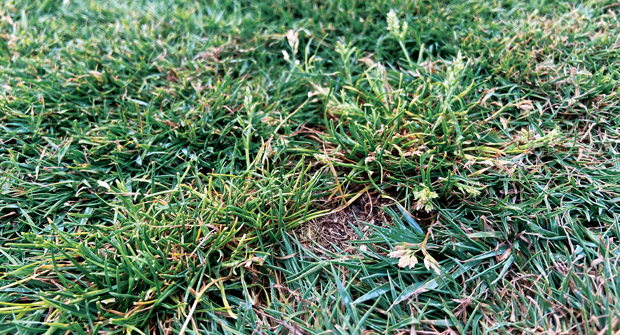
Around this time of year, Poa annua’s lighter color tends to stand out from surrounding grass as cool conditions favor its growth in otherwise more dormant warm-season turf. And while colder states get slammed with snow, Wyrick says winter rains in warm climates can break down the previous autumn’s weed prep.
“That type of thing can cause the efficacy to break down a little quicker, so you can see some problems there just depending on what product you use,” Wyrick says. “We use Specticle for our controls, and then we mix a couple other things with it to broaden the spectrum.”
Wyrick says other postemergent controls he recommends include Envu’s Revolver herbicide and PBI-Gordon’s Katana herbicide for bermuda and zoysia. On St. Augustine and centipede, he says atrazine is a good go-to since options are more limited thanks to higher risks of herbicide damage.
The broadleaf battle
While Poa can be a fight all on its own, the regular appearance of broadleaf weeds can also require some LCO intervention.
Weeds like henbit, chickweed, bittercress and more can all strike during the winter, and Wyrick says being vigilant with postemergent control is important to prevent them from growing into bigger problems.
“In January, February, you’re starting your first round of the year, which obviously you’re doing some type of preemergent,” Wyrick says. “But you’re doing postemergent control as well in conjunction to clean up winter weeds and catch them, hopefully, before they get much larger. (Now), they’re much easier to control.”
And when it comes to postemergent control on different types of grasses, he recommends Nufarm’s Cool Power herbicide since it can be used on the four main turf types.
Spring is coming
Even if there’s not inches of snow covering the turf, the winter season still serves as a slower period for warm-season LCOs. Wyrick says now is the perfect time to be planning for the busy spring and summer months ahead.
“You’re gearing up for the spring this time of year. You’re already thinking about March, April and May. Once you get through these first two rounds of preemergent and postemergent weed control, you’re on to the growing season and pushing the turf to perform the best it can for the next six to eight months,” he says.
In the January to February time frame, Wyrick says crabgrass is a prominent future issue he makes applications for, and when it comes to the product of his choice, he says his ol’ reliable is prodiamine preemergents.
“That’s for crabgrass control and a few other types of weeds,” Wyrick says. “You get longer efficacy and a little better control from breakthroughs in the spring and early summer by doing a split application. Here, we have to get that first round down usually by Feb. 15.”