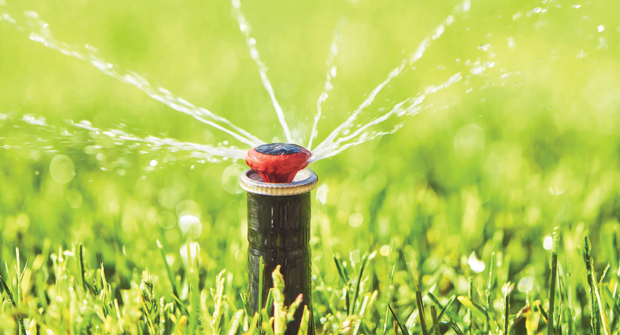
Long ago, I worked for a landscape company in the Boston area, and although I was the lawn care guy, I also helped across all the other services the company provided. This meant that I spent a lot of time on my hands and knees with my head in a hole working on irrigation systems.

We installed a ton of new residential systems, some sports fields and even an entire university campus. Most of the time, we did great work, but there were also times when we fell flat on our faces, like the time we thought we had the expertise to renovate an irrigation system at a golf course. The bosses sent me to fix that mess which took me over three months to do.
There has been a trend to want to irrigate everything, but amidst that, I think we may have forgotten something. Our landscapes should not be designed around the necessity for applied water. If the plants you install in your landscapes require a lot of irrigation just to survive, perhaps you have chosen the wrong plants. Don’t get me wrong; I am not saying that we should stop irrigating. But we do need to ask ourselves if trying to grow turfgrass in a desert or palm trees on Cape Cod is the smartest decision.
In California, the governor’s office decided to tackle this problem by banning the irrigation of what it referred to as “nonfunctional turf.” I bristle at that term, as all turfgrass has functionality in the landscape and, in this case, the term is being used subjectively — it’s nonfunctional because they don’t perceive the functionality, not because that turf is objectively nonfunctional.
In an effort to reduce the quantity of outdoor water use, California embarked on a voluntary program to remove turfgrass, with a bounty of up to $5 per square foot. But as we have experienced with many other policy issues in the past, ideas do not stay put; they migrate. In Colorado, the voluntary aspect of turf removal moved into the realm of being mandatory, with the state forbidding the irrigation of “nonfunctional turfgrass” but using the voluntary California regulations as inspiration for their policy. Left to its own devices, this notion of “nonfunctional turf” will spread like wildfire.
As a result, there is no recognition of the incredible advances that turfgrass breeders have made in developing drought-resistant varieties. I know that in my own lawn, I choose varieties for drought resistance, and despite not having an irrigation system and currently being in the middle of what the National Drought Mitigation Center refers to as a “moderate drought,” my lawn is acceptably green. Sort of. I guess it’s acceptable if you include “brown” in your definition of green.
When you consider the expectation of green among some along with the rejection of brown, ask yourself whether anyone complains when trees go dormant for the winter? I don’t recall my office phone ringing off the hook in autumn with complaints about that. Dormancy in turfgrass is a perfectly natural physiological process that protects the plant from death. We can plan around short-term drought by following best management practices such as mowing at the high end of the suggested height of cut, fertilizing properly and, if we’re going to irrigate, doing so infrequently and deeply.
Most of all, I think it’s incumbent upon us to educate our customers that, in the middle of the summer when it’s hot and dry outside, brown is perfectly OK. Embrace the brown, as I like to say.
Unfortunately, I don’t foresee this issue going away at all. We as an industry need to recognize what I see as ever-increasing calls to limit or eliminate all together irrigation of our landscapes. By all means, let’s not use turfgrass in areas like traffic islands where it’s nearly impossible to keep it alive, but let’s not throw the baby out with the irrigation water (whoa … that was bad. I am so sorry) and remove turfgrass wholesale.