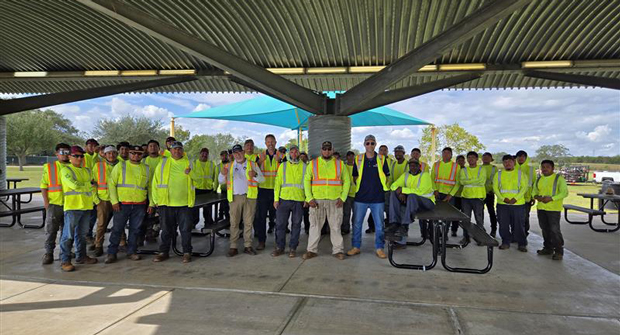
Sebert Landscape, a commercial landscape maintenance company, is on a journey to transform its operation into a lean, green, battery-powered machine.
Founded in 1985 by Jeff Sebert, CEO, the company provides commercial landscape maintenance, landscape design and construction and snow removal services, all while putting a strong emphasis on sustainability.
“The biggest reason for switching over to battery power is the sustainability factor, but there’s also noise reductions from battery-powered equipment, and we’ve seen some pretty significant fuel and maintenance savings over the last couple of years,” says Ryan Wellnitz, equipment manager at Sebert Landscape.
Wellnitz provides insight into how the company, headquartered in Bartlett, Ill., plans to push battery power throughout its entire operation.
Laying the foundation
The plan to implement battery power was not without foresight. After all, when a company boasts more than 600 employees and nine regional branch offices across Chicagoland, southeastern Wisconsin and south-central Wisconsin, a well-thought-out plan is essential for success.
Before it invested in battery-powered equipment, the company had to ensure the electrical infrastructure was in place.
This included updating the amount of power running into the facilities and yards and working with power companies to add more transformers to its yards.
“One thing that sets Sebert apart is that we own all of our properties,” Wellnitz says. “This greatly helps cut the red tape in converting to (an electric-powered) site.”
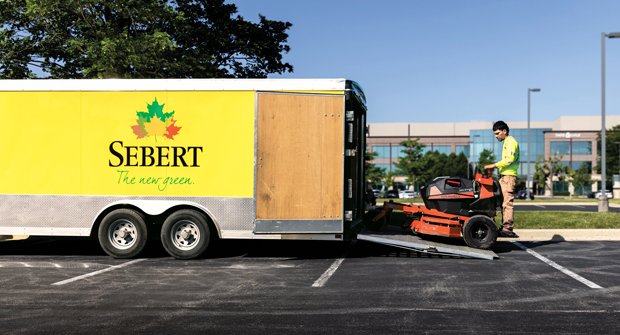
With the help of a local electrician, the company also converted its traditional landscape trailers to electric vehicle (EV) trailers by implementing on-board charging systems, manufactured by Gravely.
Within the trailers, which charge at the company’s facilities each night, there are three 20-amp breakers that can charge three mowers along with each crew’s handheld equipment.
“(With the trailers), we can not only charge our handheld equipment in the field during the day, but we also have battery reserves for any EV mowers in the field if we need any extra juice at any time during the day,” Wellnitz says. “Plus, this way, we don’t have to take any of the equipment out of the trailers at night.”
As of now, the company has 30 EV trailers, complementing the fleet’s 192 Gravely mowers, with plans to convert more as other branches within the company adopt electric. In fact, with the next branch it converts, Sebert Landscape will add 20 additional EV trailers to its fleet, Wellnitz says.
Wellnitz acknowledges it took some time to perfect the charging setup for the trailers, especially with the first branch that made the transition. Over time, the process became easier.
“Once we got that figured out, it was pretty much hands off after that,” Wellnitz says. “As we switch over each branch, we’ve had a lot of lessons learned.”
Little by little
Instead of switching all crews to battery-powered equipment right away, Sebert is making the change bit by bit by handling one branch at a time. The initiative began with the company’s main branch in Bartlett, Ill.
At this point, Sebert has switched about 25 percent of its operations to battery power, according to Wellnitz, and four out of the company’s nine branches have been converted, with a fifth to make the transition in early 2026.
The switch includes equipment such as mowers, string trimmers and some blowers, although the company
is slower to transition gas-powered blowers to battery-powered ones.
“A lot of companies have developed electric backpack blowers, but they’re just not quite as powerful as the gas ones yet,” Wellnitz says.
Over the next several years, Sebert Landscape plans to transition the rest of its operation to battery power. As the season begins for 2026, about 34 percent of the mower fleet will be EV, and all the crews that have EV mowers will have electric handheld equipment.
While the decision to convert to battery power initially revolved around sustainability efforts, the transition also comes amid growing pressure within U.S. cities to limit gas power, Wellnitz says.
“We’re seeing a lot of municipalities passing legislation to ban certain gas-powered equipment. It’s especially true in coastal areas,” Wellnitz says. “It’s not so much an issue in the Chicagoland area yet, but I foresee it coming here soon.”
Reduced overall maintenance costs in the long run also played a factor in the decision to embrace battery power.
In the coming months, Wellnitz, who began at the company earlier this year, says he’s looking forward to digging into how much the battery power transition has saved the company over the long run — not only in fuel, but also in maintenance costs.
“Already, we’ve saved a lot in terms of gallons of propane to power the mowers, and the reduction in maintenance costs is huge,” says Wellnitz, citing not only the cost of mechanical labor to repair equipment, but also the cost of replacement parts and the cost of downtime while waiting for equipment to be repaired.
Finally, there also have been some beneficial side effects to switching to battery power. For example, crew members enjoy less noise and no exhaust fumes by using battery-powered equipment.
“Our employees have also found that the equipment is easier to start than gas equipment — you have immediate run time with electric equipment, and we are not trying to pull-start equipment over and over again,” Wellnitz says. “There’s also no gas to mix, no greasing of the machines, no oils, filters or spark plugs to change and no belts to maintain.”
Words to the wise
For other companies looking to make the change to battery power, Wellnitz recommends first choosing a trusted manufacturer that offers strong support.
“We have a really good relationship with our manufacturer. We can call them on the phone, and whether we need tech support or even boots on the ground, they’re willing to jump in, help us tackle the issue and come up with a long-term solution,” Wellnitz says.
The next step, Wellnitz says, is that landscape companies should provide adequate training for employees in the field. This move can help clear up crew members’ preconceived notions about the equipment.
“Crews are used to gas-powered handheld equipment, so when you first introduce them to the new equipment, they might say something like, ‘This doesn’t have enough power,’ or ‘The batteries won’t last,’ so that’s why we do pretty extensive training with them,” Wellnitz says.
For its training sessions, the company sets up a ride-and-drive obstacle course so employees can become familiar with the machine as well as stations pertaining to different aspects of the equipment. Stations include topics such as:
- How to change and sharpen blades.
- How to plug in the mowers inside the trailer.
- How to plug in the trailer to store power for overnight charging.
- Mower safety features.
Finally, Wellnitz says it’s essential that everyone within a company embraces the change to battery-powered equipment in order for it to be successful.
“The initial investment upfront is huge, but the one thing you really have to focus on is the long-term gains and remember that you’re buying your fuel and equipment upfront,” Wellnitz says. “And then also think of the long-term vision of supporting sustainability and reducing greenhouse gases.”