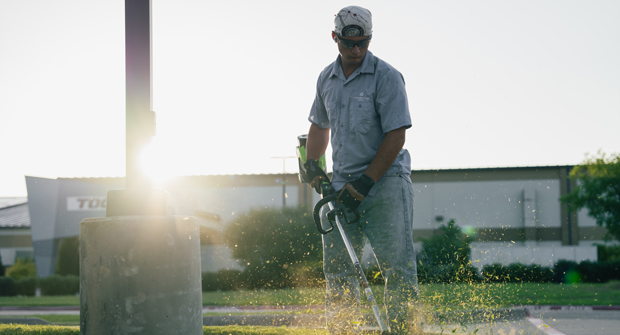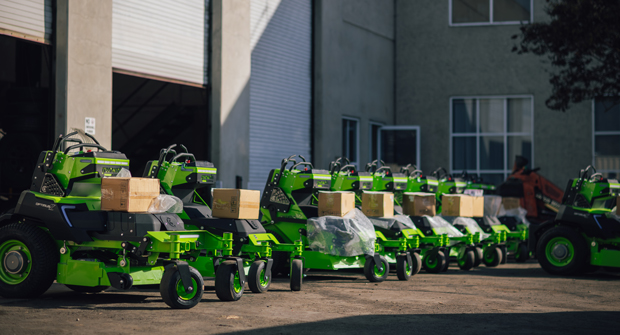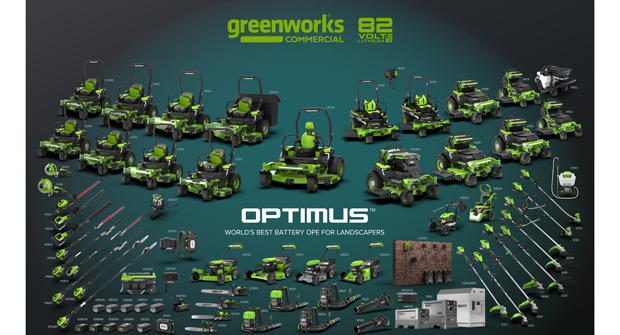
Greenworks’ decade-long effort to develop a best-in-class, battery-powered commercial equipment platform has culminated in the release of the Optimus family of mowers and handheld tools, a line specifically designed for the professional landscape and lawn care industry.

This platform represents a significant leap forward from Greenworks’ earlier commercial offerings in this category, which CEO Yin Chen admits did not meet the rigorous demands of commercial contractors. Consequently, Greenworks went back to the drawing board in 2021 with the explicit goal of not just matching but beating gas performance across key metrics.
The resulting Optimus platform, which includes zero-turn mowers, walk-behind mowers and a complete portfolio of handheld equipment, was achieved by Chen challenging his engineers to create the best possible design in battery performance, motor control and chassis construction, with many innovations drawing on key elements of electric vehicle (EV) design.
Greenworks achieved what Chen scores a 9.5 out of 10 performance level with the OptimusZ mowers, and extended this philosophy to handheld tools, balancing power, durability and longer runtimes to create tools that outperform gas-powered alternatives while being more economical.
Under Chen’s leadership, Greenworks has made a significant contribution to the professional landscape and lawn care industry. However, he believes the company has only scratched the surface of this technology’s potential.
In the near term, Chen asserts that the undisputed next phase of the commercial landscape industry is autonomous equipment. Therefore, he is leading Greenworks’ research and development efforts in this direction with a specific plan to introduce an autonomous commercial zero-turn mower.
“With autonomous mowers, crews will drive the landscape trailer to the jobsite and simply push a button for the mower to begin cutting while the crew performs other tasks like trimming and leaf collection,” Chen says. “This autonomous capability could potentially reduce a three-person crew down to a two-person team, immediately benefiting the contractor’s bottom line.”
According to Chen, Greenworks has ambitious plans on the drawing board to launch several robotic mowers during the 2026 season.
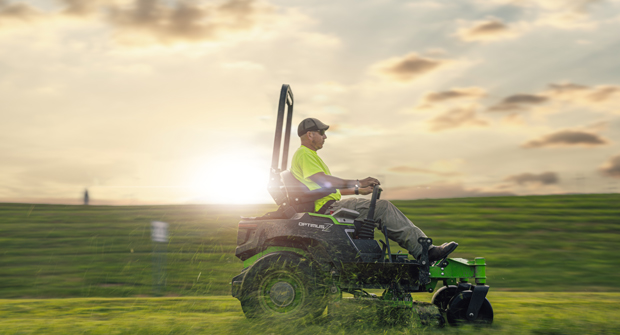
“It’s going to be interesting to see how fast we can move that so that people will say, ‘Wow, autonomous technology is here to stay,’” he adds. “But it must be good enough, strong enough to do any type of work.”
Chen believes the safety benefits of autonomous operation will drive much of this integration. For example, environments with high risks for personal injury, such as steep slopes on commercial properties and around water features, are often too dangerous for manual operation. Autonomous or remote-controlled mowers will allow maintenance crews to manage these dangerous or tricky areas better.
“Our organization is spending a lot of hours in that direction,” he says of the shift toward autonomous operation. “All our OptimusZ mowers will be retrofit-capable to make them upgradable with autonomous function. This will help the industry not only transition from gas to electric, but from electric to autonomous.”
Beyond autonomous capabilities, Chen envisions that smart, digital, and multitasking systems will strengthen Greenworks’ equipment solutions. This involves more than just self-driving mowers. It will encompass an entire digital ecosystem, he says, adding that this system will include tools like drones to analyze job sites and various digital devices to help professionals with planning and data feedback.
And Chen fully anticipates artificial intelligence (AI) will play a critical role in Greenworks’ evolution to smart, autonomous landscaping equipment.
For example, camera-based AI applications, inspired by Tesla’s Full Self-Driving (FSD) technology, will be applied to Greenworks’ robotic mowers. The core concept, according to Chen, is that these machines will become progressively smarter by collecting and learning from operational data in the field.
And to facilitate this rapid improvement, Greenworks maintains a dedicated AI data center in Toronto. Here, a specialized team works on computer analysis to refine the responsiveness of robotic and autonomous landscape and lawn care equipment. This direct integration of AI with end-user interaction is paramount, Chen says, ensuring the autonomous function is consistently optimized.
These innovations will enable Greenworks to become an industry leader in making “smart equipment even smarter” for landscape professionals, he adds.
“For Greenworks, the goal is to lead both transitions,” Chen says. “Greenworks currently leads the movement from gas to battery, and we intend to continue this leadership by providing a comprehensive, end-to-end ‘smart landscaping’ solution. This will be a complete system that covers all aspects of the landscape professional’s needs, ultimately making their lives better and more efficient.”
Mike Zawacki is a Cleveland-based journalist and frequent contributor who has covered various aspects of the green, horticultural, sports turf, and irrigation industries for the last 20 years.