SUBSCRIBE


Battery-powered commercial equipment has reached a point where many landscape contractors are no longer asking whether the technology can perform.
Advances in runtime, charging capabilities and commercial equipment options have made battery a viable consideration for more crews and applications. Beyond replacing fuel, reduced engine maintenance, quieter operation and fewer fuel-related interruptions can all influence crew productivity and operating costs.
For contractors evaluating their next fleet investment, the question is increasingly where battery can deliver the greatest operational advantage. And answering that question starts with understanding the work itself.
Solving the battery equation
Landscape companies manage diverse routes, properties and workloads, and equipment that makes sense for one crew may not be the right fit for another. Contractors should look closely at route length, property size, equipment utilization and expected runtime throughout the day.
Understanding how equipment is used in the field provides a much better foundation for fleet decisions than simply comparing specifications.
Runtime and charging must be planned together. Crews on predictable routes can easily recharge or swap batteries, but higher-utilization operations require extra planning to avoid midday downtime.
This is one area where planning matters. A common mistake is purchasing battery-powered equipment first and figuring out charging later. Before converting equipment, contractors should consider where batteries will charge, when charging will occur, how many batteries each crew needs and whether existing electrical infrastructure can support the operation.
Property type matters, too. Schools, hospitals, hotels, residential communities and corporate campuses may have noise restrictions or customers who prefer quieter maintenance. Battery-powered equipment gives crews greater flexibility to service those properties during hours when louder equipment may be disruptive; that flexibility can make certain routes or accounts particularly strong candidates for battery adoption.
Maintenance is another important part of the business case. Battery-powered equipment eliminates many routine engine maintenance tasks associated with gas equipment, including oil changes, spark plug replacements and fuel management. Reducing those service requirements means fewer maintenance hours, less equipment downtime and more time in the field.
A deliberate process
Contractors can electrify their fleets in phases by starting where battery power offers the clearest advantages. This allows you to test performance in real-world conditions and use those insights to guide future investments.
A contractor might start with a crew servicing noise-sensitive properties or choose routes where runtime and charging requirements are especially predictable. Another option is to prioritize heavily used equipment categories where reducing maintenance or fuel use can create a clear operational benefit. Contractors can then track runtime, charging patterns, maintenance, crew productivity and equipment utilization. Those results can help identify additional opportunities for battery adoption.
That real-world data is valuable because it allows contractors to make fleet decisions based on their own operations rather than assumptions. Understanding how equipment performs on actual routes can reveal where battery delivers the strongest business case.
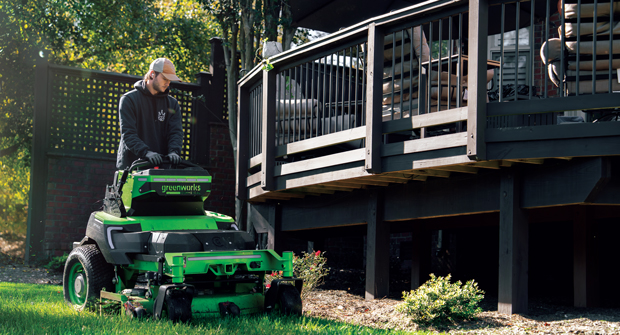
Contractors should also think beyond individual machines. As adoption expands, batteries, chargers, equipment and mowers should work together as a system. An integrated platform reduces complexity across crews and makes it easier to scale without introducing a different battery or charging strategy every time more equipment is added. Greenworks Commercial’s Optimus platform uses this approach; it brings commercial equipment, battery technology and charging solutions into an ecosystem designed to grow alongside an operation.