SUBSCRIBE


Show of hands: How many of you have heard of Ophiobolus patch? Anyone? Anyone? Bueller? Bueller? No, I am not trying to show off my plant pathology skills (because I really do not have any) but rather to demonstrate a point.

The time since I graduated from college is measured in decades instead of years, and things have changed mightily. The Ophiobolus patch that Joseph Troll, Ph.D., at the University of Massachusetts Amherst insisted that we understand inside and out no longer exists.
Well, that’s not exactly true. The constant drumbeat of new research has led pathologists to more accurately describe the disease — today it’s called take-all patch. So too the way we treat it: In his 1962 textbook, “Diseases of Turfgrass,” Houston Couch, Ph.D., recommended applications of phenylmercury acetate for control. In fact, none of the fungicides Couch mentions in his book remain on the market (thank goodness).
This is a fantastic example of the adage that you do not go to school to learn specifics, per se. Rather, you go to school to learn how to learn. Knowledge is constantly evolving, changing and rearranging. What was gospel one year can easily be tossed upon the ash heap the next. To keep pace professionally, you must make it a priority to keep learning all the time. The trick is figuring out how to keep up with the evolution.
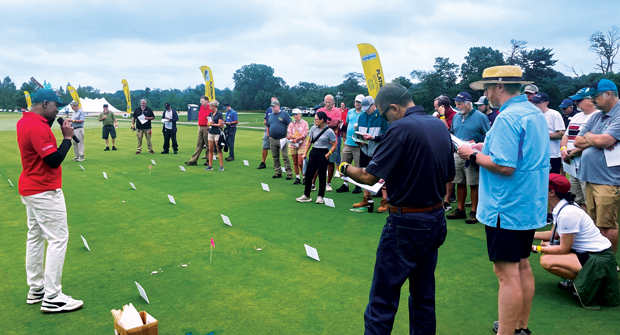
One way to do this is to attend a turfgrass field day event. This past July, I hopped into my car and headed to the annual Rutgers Turfgrass Research Field Days in New Jersey. This event was held over two days, the first of which focused on golf, while the second focused on lawn and sports turf. Their research farm in Freehold, N.J., has 150 acres of turfgrasses, plus plenty of weeds, insects and diseases to boot.
Events like this are mini classrooms for field personnel. There, I met one lawn care colleague who brought a dozen or so lawn specialists along with them for a day of training that they will be able to put into practice immediately. Hearing from top turfgrass experts and seeing their work in person is a powerful experience.
Universities across the nation hold turfgrass field days all summer. You should attend them. During the winter off-season, you can still build your team’s knowledge through events hosted by universities and state associations.
It’s not all the same old, same old either. I have been working with my colleagues on training presentations to address new pesticide-use requirements under the Endangered Species Act (ESA). Although I am feeling much better about how this effort will impact the landscape industry, it is still the biggest change in how we utilize pesticides since the federal pesticide statute, the Federal Insecticide, Fungicide, and Rodenticide Act (FIFRA), was amended in 1972.
We will not be able to train everyone in one fell swoop, either. This is one of those topics in which you’ll have to hear about it a few times to get a handle on what’s required. If you happen to be part of a state association that hosts a winter training event and you’d like to have someone do a session on ESA compliance, drop me a line. I’m happy to help.