 SUBSCRIBE


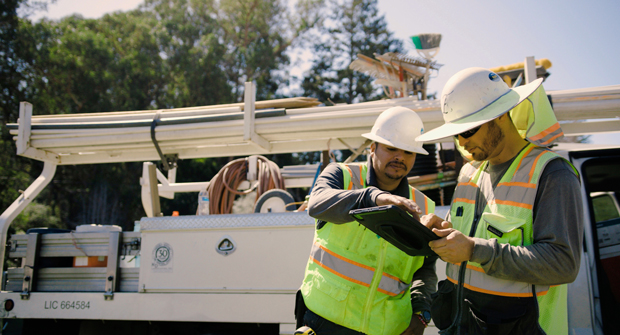
A digital shift is underway in the landscape industry, and artificial intelligence — AI — is at the center.
Between managing business challenges influenced by escalating operational costs, labor uncertainty and unrelenting market pressures, running a successful landscape and lawn care operation requires solutions that put contractors a step ahead of their competition.
To meet these business challenges head-on, many industry professionals are doubling down on integrating AI into their operations, whether through generative content creation or agentic applications built into business management software.
However, landscape pros are notoriously pragmatic, and their interest in AI is less trend-driven and more focused on how this rapidly evolving technology can improve margins, address labor needs and strengthen customer satisfaction. In response, tech companies serving the industry are implementing AI-based solutions that take administrative and data management tasks off the shoulders of time-stretched owners and managers.
Landscape contractors are inherent problem solvers who excel at overcoming operational hurdles, whether that’s scaling their labor force or transforming a vacant property into a living environment. Consequently, contractors seek strategic leverage to drive efficiency, accommodate more clients, accelerate growth and better empower their workforces.
AI can provide this strategic leverage, says Mark Sedgley, CEO of Granum, and it’s why the topic needs to be part of the industry’s discussion about streamlining administrative and strategic workflows.
“(Landscape contractors) use tools every day to make their jobs more efficient, to get to the next job faster, to ease the burden on their employees,” Sedgley adds. “That’s exactly what AI is: a highly leverageable tool to make their business more efficient. That’s why they should be thinking about it and exploring it.”
The disconnect
Tech experts warn landscape and lawn care professionals that AI is not a golden ticket for their businesses.
“One of the biggest misconceptions is that AI is already fully dependable and capable of making business decisions with perfect accuracy,” says Bill Benoit, vice president of sales and marketing at The Integra Group. Benoit is also a landscape industry veteran, having spent more than two decades in managerial roles at various landscape companies.
In reality, today’s generation of AI technology remains inconsistent. For example, when queried multiple times with the same prompt, AI may yield varying results. This lack of absolute reliability poses a significant risk to contractors.
“This is important to understand because landscape contractors rely on mission-critical software to provide accurate information when it comes to financial management, job costing, payroll, scheduling, estimating — all of those things,” Benoit says. “If contractors are not 100-percent accurate 100 percent of the time, a small error in cost calculation or labor analysis can be really expensive.”
Another misunderstanding is that AI drives or manages business software. More accurately, AI operates within a specialized layer inside the software application, functioning as a supplementary tool rather than as its core engine.
In terms of daily operations, AI is highly capable of automating redundant tasks that no longer require human intervention, such as responding to basic customer inquiries about services and scheduling availability. However, Sedgley cautions that these touch points should not be overlooked as high-leverage opportunities for meaningful human engagement. Therefore, he recommends striking a balance between AI-managed tasks and those requiring human intervention.
“There’s going to be an evolution in picking and choosing strategically, on a company-by-company basis, what gets remediated and defaulted to AI task management and agentic delivery versus how (a landscape contractor) differentiates themselves through engagement and human activity,” Sedgley says.
“I think companies will win based on both routes, strategically. I don’t think one (AI vs. human interaction) trumps the other. It’s going to be based on what your strengths are and what your weaknesses are.”
Like most people, landscape contractors often confuse everyday, publicly accessible AI applications like ChatGPT with highly advanced, AI-augmented software systems designed to automate and transform complex workflow tasks, says Drew Wagner, founder and CEO of LaunchPad. These are two very different applications.
“It’s the concept of intelligence and judgment,” Wagner says. ”I think (AI-infused software) systems are extremely intelligent, but I don’t think they have wonderful judgement. And a lot of that is they don’t have something on the line, like a person does. There’s a big debate right now about whether AI is going to be the human replacer or the human augmenter.”
For example, traditional business software relies on rigid, binary logic that routinely fails to account for unexpected scenarios that fall outside the day-to-day norm. As an augmenter, modern AI introduces a layer of dynamic evaluation capable of assessing nuances that traditional programming misses, Wagner says.
“I’m very bullish on the augmenter case,” Wagner says. “There are a lot of things in humanity from a relational perspective that the logic may not make sense, but it’s the right thing to do. I don’t think AI is able to capture that in the same way a human does, and so I think that those are going to be just big things to play out over the next couple of years as we continue to see (AI-infused business software) roll out.”
Adoption is complex
Aspire Software’s Eli Zevin sees a sharp divide in AI adoption within the landscape industry. For small- to mid-market contractors, apprehension is a significant barrier to entry. These business owners frequently struggle to determine how best to use AI applications while finding time to invest in long-term implementation.
“There’s a very funny cartoon of a caveman who’s carrying a wheelbarrow with square wheels, and he’s essentially saying he doesn’t have the time to (consider) circle wheels because he’s already invested in square wheels,” says Zevin, the tech company’s general manager. “It makes me think about a very real challenge for us as a software company and how we can give landscape pros a turnkey experience utilizing AI that does not require the time to invest, which sometimes is the blocker to entry.”
Conversely, larger commercial landscape companies are aggressively pursuing AI technology, Zevin says, often employing dedicated internal teams tasked with auditing operational processes and identifying strategic insertion points.
“They’re finding opportunities to insert AI to make them more efficient,” Zevin adds. “So, it’s wildly different, depending on who you talk to.”
The primary hurdle, though, is shifting landscape contractors from casual experimentation to practical implementation. While many businesses in this segment experiment briefly with free versions of large language models such as ChatGPT, Zevin says the real challenge is determining how the technology fits into daily workflows and into the specific roles of individual employees.
“This is a big hill to climb,” Zevin says. “And it sounds very cliche, but just get started. You have to take step one and set aside the time to do that. I know it’s easy to say and harder to do, especially when you’re operating a business and wearing multiple hats, concerned about all the stress and challenges of running a landscape operation.
“Nonetheless, the businesses that take that step start to see this is going to be worth it, this is going to pay off, this can be part of how I hit my goals this year,” he adds. “So, you buy in, and then it goes pretty quickly from there.”
The difference maker
Many tech insiders emphasize that AI-based technology should be applied selectively rather than universally.
While certain operational challenges are uniquely suited for AI and large language models, Brian Brinkworth, Aspire Software’s senior director of product management, says other customer needs are more effectively addressed through non-AI methods, such as predictive statistics. Ultimately, Brinkworth maintains that software development must prioritize the client’s desired outcomes, fanatically pursuing whatever specific technology — whether AI-driven or traditional — delivers the most impactful solution for the problem at hand.
In the short term, software developers have identified various areas where AI improves the contractor experience within an overall software platform.
One such area is customer onboarding, where AI can ingest vast amounts of legacy data, intelligently transform it and ask targeted questions to streamline the initial setup process.
Additionally, AI allows contractors to easily generate well-formed, targeted messaging for clients, Brinkworth says. Similar to the widespread AI assistance in mainstream word processors, large language models allow contractors to instantly adjust their client communications to be more concise or verbose. This capability alleviates the pressure on contractors to obsess over crafting a flawless message, ensuring they start on the right foot with prospective clients or when managing major projects.
AI can also quickly translate and enhance maintenance team field notes into highly professional, polished reports, especially in instances where English is a second language.
“We want to shorten the time from that insight, or something that (workers) are observing with a site or quality audit, and then get that message from that person out to the property manager or the property owner,” Brinkman says. “It helps the communication be extremely professional and in a language the end-user wants it to be in.”
Regarding contractor interaction, Wagner says embedding AI into core software transforms how they navigate business systems.
“AI is allowing contractors to simply tell an AI agent what they want to achieve rather than navigating dozens of different menus,” Wagner says. “The (AI) agent evaluates the request, establishes a plan and executes the task, prompting the (contractor) only when feedback is required.”
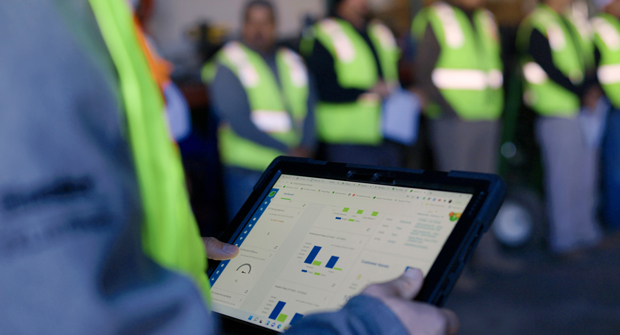
Contractors specialize in landscaping, not data science. AI transforms raw, overwhelming datasets into actionable intelligence, executing in seconds what used to take hours of manual analysis. For years, the average contractor has been amassing data on labor, equipment costs, routing, client histories and schedule trends.
It’s not a lack of data that hurts the average landscape pro, Benoit says. Instead, the average contractor lacks the time and expertise necessary to identify operational trends, recognize profitability patterns and detect business anomalies to apply changes in meaningful and profitable ways.
AI bridges this gap by serving as an efficient analytical partner. Imagine the value gained from quickly identifying the least profitable maintenance contracts ahead of renewal season.
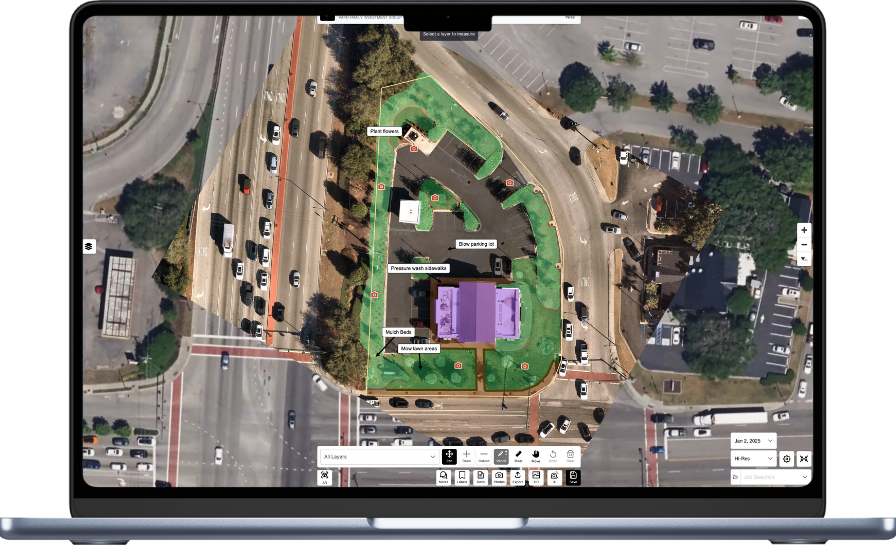
“AI helps in identifying trends,” Benoit says. “It helps detect operational inefficiencies, surface anomalies within the business, improve forecasting, recognize profitability patterns, optimize routing and benchmark the performance of one crew against another, branch against another branch.”
AI is not a disruptive wave for the landscape industry to resist, but an inevitable evolution that is seamlessly merging into daily operations, embedding itself within contractors’ existing software ecosystem and serving as a high-leverage tool that handles routine friction points and uncovers operational opportunities.
By automating and optimizing everyday workflows, such as generating precise estimates, managing jobsites, streamlining invoicing and improving client communication, Sedgley says AI frees landscape operations from administrative bottlenecks.
“If you were to say to any business, ‘I’m going to help you gain visibility into your numbers, reduce expenses and create more profitability,’ you’re going to invest in that to grow, right?” Sedgley says. “Water goes where water flows. There’s no stopping it. AI should just naturally flow into the software, making a contractor’s job easier, their day-to-day experience easier and touch all the points they utilize every day to write better estimates, to manage a job, to build an invoice, to communicate with their customers and to attract new customers.”
Zevin stresses that AI will, for the foreseeable future, never run a landscape business on its own because the industry’s unique complexity requires human ingenuity.
“AI really can only do things that have already happened,” Zevin says. “It might be able to do them really, really well, but in terms of thinking — what the next version of a landscape business looks like or the way to run these operations that no one’s thought of yet — AI is not going to be able to do that. It’s going to be the landscape operator. It’s going to be the person who has that experience, who’s thinking creatively and differently.”