 SUBSCRIBE


Editor’s Note: “Time for Some Good News” is a feature that spotlights the good deeds, great people and positive stories in the landscaping industry. If you have your own good news to share, reach out to Seth Jones at sjones@northcoastmedia.net or Scott Hollister at shollister@northcoastmedia.net.
It’s 2020 in New Jersey — the height of the COVID-19 pandemic. Brian Schwartz, who’d usually commute to New York for work in the advertising industry, is now sitting at home after his firm, like many others at the time, goes out of business.
Adding fuel to the fire, Schwartz’s wife was also eight months pregnant, and he had a terminally ill father at the time, compounding what he described as “a lot of stresses both internally and externally that were out of my control.”
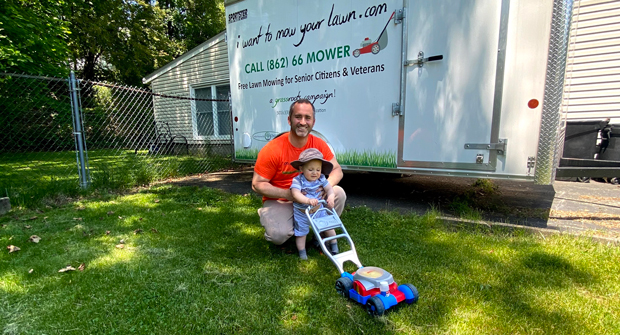
But Schwartz had at least one trick keeping him grounded: mowing the lawn. He said he found it almost therapeutic amidst the craziness of that year, and he decided to turn that feeling into a force for good.
“It was more so a way for me just to stay busy until I figured out the next step in my life … I had some extra time while becoming a new father,” he says. “One thing led to another where I set up a simple website — which is now known as IWanttoMowYourLawn.com — without much of a plan. I didn’t even intend for it to be a nonprofit. It was just contact information and a way to get in touch.”
After running some local ad campaigns to stay active in advertising, Schwartz says he got a few inquiries. But what followed was, as he described, the “perfect storm.”
“I started to get too many inquiries. I started to get local press coverage and started to just promote the website, and people were getting in touch. And it got to a point where I had probably a dozen homes that I was getting around to — elderly neighbors, veterans, others who couldn’t afford or manage it themselves, the homes that would otherwise go unattended,” Schwartz says. “I was also thinking about my late grandfather who passed away just months prior to the pandemic. Thankfully we had a proper burial, so I just can only imagine the stress people were going through thinking about their older parents.”
Soon, I Want to Mow Your Lawn became a national headline, and Schwartz needed some infrastructure upgrades to organize the now thousands of service requests and volunteers trying to come in. With some help from outsourced software firms and developers, Schwartz transformed the website and its backend into a logistical powerhouse, using AI to filter calls and requests by level of need, location and more, helping connect that person to a nearby volunteer ready to provide temporary relief.
“AI is here to stay in some capacity, right? And so, for me, even though it’s not my real job — it doesn’t pay me anything — I’m finding great joy in embracing it and almost viewing this as a sandbox, but for real-world impact that (shows) AI can be used for good,” Schwartz says. “I’m fixing bugs and patches that help connections get made that would not have been made without the assistance of AI.”
Schwartz also launched the new MOW mobile app early this spring, further helping organize the now national nonprofit. He describes it as an easy-to-use volunteer coordination tool, allowing users to log volunteer hours, upload photos of completed work, schedule visits without needing to share sensitive contact information and play a new daily lawn care puzzle.
The app is just one of the many ways Schwartz is trying to further encourage the industry to help out, as the site has logged more than 12,500 requests for help. The website also allows for donations to be made that go right back into the system, providing equipment upgrades for volunteers, volunteer accident insurance and more. A new “Pay it Forward” initiative also lets landscapers donate or lend out unused equipment to those looking to volunteer.
“We’re a temporary safety net, not a replacement for the pros,” Schwartz says. “Even one time makes a difference, so we could use all the help we can get.”
Interested in volunteering? Register to help out your community at the I Want to Mow Your Lawn volunteer webpage.