 SUBSCRIBE



It’s often referred to as the “Tesla Effect.”
The term describes a rapid, technology-driven transformation that has a profound impact on an established industry. This phenomenon is fueled by a combination of innovation, consumer perception and aggressive vertical integration, with cutting-edge battery technology serving as the foundation.
Recently, the commercial landscape industry has witnessed the emergence of its own Tesla Effect. Simply put, this trend has accelerated the industry’s transition away from traditional gas-powered mowers and handheld equipment toward high-performance, battery-powered alternatives.
Recognizing this dramatic shift, landscape equipment leaders are now bringing to market advanced battery-powered product lines.
Greenworks CEO Yin Chen recently credited Tesla with having a profound impact on his company’s strategic direction. Chen points to the electric vehicle (EV) manufacturer’s success in performance and battery engineering as setting a higher standard that Greenworks adopted. This led to a “back-to-the-drawing-board” engineering philosophy, which, after a decade, culminated in Greenworks’ Optimus line of commercial-grade, battery-powered mowers and handheld equipment.
“Tesla has done a lot to really open people’s minds,” Chen says of the influence on the next generation of mowers and handheld equipment. “A lot of (Greenworks’) ideas and inspiration have come from an understanding of (the Tesla process). I think Tesla didn’t only motivate the industry, but it’s also inspired our society.”
The advent of battery technology is not only influencing equipment manufacturers. Its competitive advantages — including fuel and oil elimination, reduced maintenance, client attraction and employee retention — are challenging professional contractors to reassess their business models and operational dynamics. Ultimately, this technology is forcing the industry to redefine limitations and speculate on the future direction of mower and equipment innovation over the next decade.
Viva la revolution
It wasn’t too long ago that battery technology was considered a niche solution, underperforming and suitable only for the less-demanding homeowner market. However, new approaches to engineering lithium-ion battery cells have improved both performance and durability compared to their traditional gas-powered equivalents, says William Rigdon, director of battery and charging technology at Stanley Black and Decker.
“Innovations such as pouch and tabless cell designs, as well as new materials like high-nickel and single-crystal cathodes, conductive additives, ceramic-coated separators and synthetic graphite, have led to batteries with greater power density and longer runtimes and life-
spans,” Rigdon says.
This scale-up over the last five years has driven down costs while increasing energy density, key factors in making heavy commercial applications like zero-turn mowers and handheld tools technologically and financially feasible for landscape and lawn care professionals.
This transformation is not solely attributable to better batteries but to the synergistic advancement of numerous key technologies within the equipment itself, says Bradley Berkman, a product manager at Milwaukee Tool.
“We always say, ‘batteries, motors and electronics,’” Berkman explains. “What has let us push the boundaries of (equipment) performance and application is being able to enhance and drive all three of those technologies forward.”
Improvements like enhanced battery management systems, optimized cell chemistries and improved thermal management have boosted the performance and durability of lithium-ion cells for commercial landscape equipment. These advancements include improved energy density, longer cycle life, faster charging and greater tolerance to temperature fluctuations. Additionally, integrated safety features like overcharge and short-circuit protection further enhance durability.
“If you look at the entire industry, in the last 10 to 15 years, batteries have improved enormously in terms of power longevity and energy density. But if you look at (gas-powered equipment), nothing has really changed,” Berkman adds. “So, if you grab a string trimmer from the late 1990s and tear it apart, it’s going to have the exact same components that it has today. And from a developmental standpoint, there’s such a long runway with battery equipment where we’ve really seen it continue to get better. We don’t expect that to slow down any time soon.”
Substantial investment by the equipment manufacturing sector has fueled much of the evolution in battery technology, says Ryan Kropfelder, a senior product manager at Stihl.
“The density of power that we’re able to put into these (battery) cells, even in the last 10 years, has continued to get better year over year,” Kropfelder says. “And manufacturers are making significant engineering investments into the equipment itself. The sophisticated nature of this development means that the battery management systems, these PCBAs (printed circuit board assemblies — intelligent control centers within the battery), the technology within the tools and how the tools communicate with the batteries, it just gets better year over year because we learn more.”
Smart power
One phrase bandied about in the equipment industry is that “battery power is smart and gas is dumb.” This unofficial slogan encapsulates the fundamental advantages of modern, commercial-grade electric equipment over traditional 2- and 4-cycle engines.
According to John Powers, a director of product management at Echo, the most significant opportunity for equipment-driven labor savings lies in autonomous applications. However, he notes that certain jobs requiring human judgment — such as tree trimming, where real-time decisions are necessary — are extremely challenging to automate.
Mowing, however, is the area where autonomous operation is already a reality. Powers says the approach to autonomous mowing taken by various equipment manufacturers — Echo included — has been geared toward larger-scale applications like sports fields and large properties, rather than the small residential robots seen elsewhere. This technology presents a prime opportunity for labor savings in grounds maintenance, especially for complexes with multiple fields or large expanses of turf. However, it may be less applicable for landscapers focusing solely on residential property maintenance.
The “smart/dumb” phrase also refers to the technological intelligence built into these modern battery-powered systems, and the operational and business intelligence available to the professional contractors who adopt them.
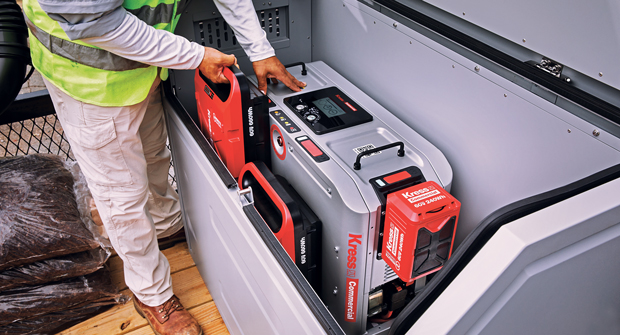
For example, battery-powered equipment depends on advanced charging systems that optimize infrastructure limitations.
“Most contractors are limited to the 15-amp standard outlet,” Stihl’s Kropfelder says. “This creates a challenge to optimize charging and get (batteries) charged as quickly and efficiently as possible.”
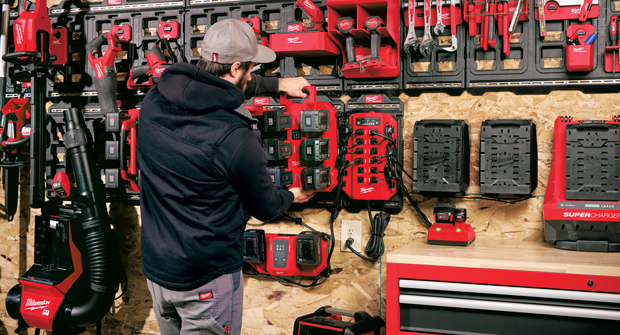
The equipment industry has responded to this necessity by introducing systems that transition output from the contractor’s electrical outlets to an intelligent charger that manages power distribution and maximizes delivery to multiple batteries simultaneously. The goal is not to overload electrical systems during overnight charging while also ensuring the batteries are fully charged and ready to use at the start of the next day.
Numerous equipment providers have also begun addressing the need for smart mobile rapid-charging solutions, which manage on-the-go battery power replenishment directly from the landscape trailer.
According to Kropfelder, the debate about maintenance crews carrying multiple battery packs versus the advantages of mobile charging fewer batteries rests on two factors: the ability to provide power at the jobsite via portable power stations or battery banks and rapid recharge times (10 to 15 minutes). The answer, he concludes, will likely involve a convergence of these two solutions.
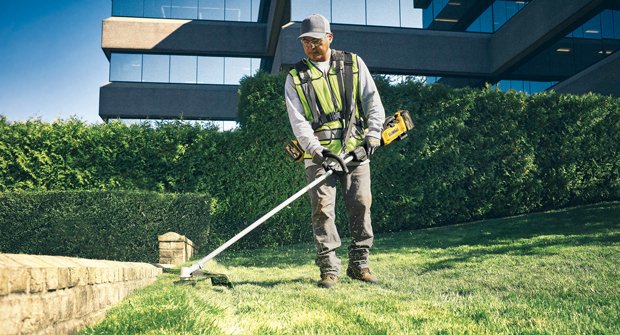
“(The industry) hasn’t cracked the code on this just yet,” Kropfelder says. “But as soon as we can marry those two things together, I think we’ll be able to do that.”
And while artificial intelligence (AI) is expected to play a role in streamlining design and engineering processes, advanced machine learning could be valuable for more effective and efficient equipment operation. This digital infrastructure captures valuable data from tools, providing contractors with details about how long a piece of equipment ran and at what RPMs operators were running that equipment. A contractor can then use this data, plug it into an AI system and receive a more efficient workflow model.
“By leveraging sensors and data analytics, machine learning has the potential to support safety features, enable predictive maintenance, enhance fault detection and optimize (equipment) performance,” says Stanley Black and Decker’s Rigdon.
More to come
Has battery technology arrived at a golden age in its application to landscaping and lawn care equipment? While the question is intriguing, many believe this era is only the beginning.
“Describing the state of battery-powered equipment as being in a ‘golden age’ suggests an end state,” says Powers. “I don’t think that’s where it is. There’s still quite a bit of development to come in the future.”
Innovation in battery technology generally trickles down from other high-tech sectors. Unlike areas such as irrigation or pest and weed control, where technology often flows from agriculture, the advancements relevant to the landscape equipment industry are driven by other sectors that invest heavily in battery development, such as automotive and construction.
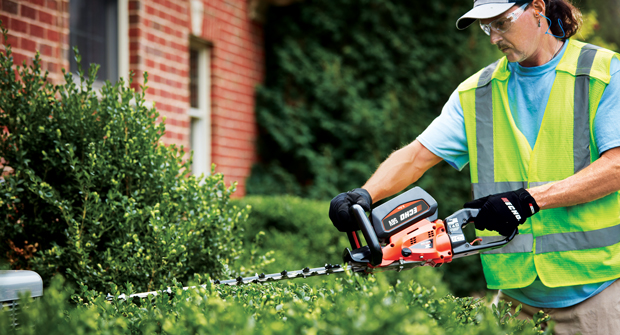
While current handheld tool performance is on par with, or in some instances exceeds, that of its gas-powered counterparts, other categories require additional development.
Using battery backpack blowers as an illustration, Powers explains that while their performance is strong, the primary hurdle remains weight and extended runtime, challenges directly linked to battery-pack technology.
“From a pure technology standpoint, we can make a backpack blower that can output the same power as a gas unit with the same runtime,” Powers says. “It’s just too heavy for anybody to use because you need … probably 30 or 40 pounds worth of batteries.”
As overall battery capacity technology improves across other industry sectors, Powers says these innovations will trickle down for application in professional landscape and lawn care equipment, driving next-generation performance.
One such advancement is tabless cell technology, which Kropfelder says holds a lot of promise for improving battery-powered equipment. In battery design, tabless cell technology removes the traditional thin metal tabs used to connect the electrodes. Instead, it utilizes the entire edge of the electrode as a continuous current collector, creating a more direct, lower-resistance path for electricity. This design leads to reduced internal resistance, lower heat generation and higher power output, enabling faster charging and discharging for improved performance in power-demanding tasks such as mowing and landscape maintenance work.
“These cells are much better for heat management, much better at temperature control, and then obviously, they give you better charging speeds, runtimes and power,” Kropfelder says, noting that this technology enhances both performance and safety for users.
Battery-powered performance has not only caught up to gas, but in many product areas, it exceeds it in performance and represents a game-changer for equipment solutions. And it is merely the beginning, says Per Kvarby, vice president of product management and marketing for the commercial business unit at Greenworks.
“Battery technology is evolving at an unprecedented rate,” Kvarby says. “Within the next two to three years, battery-powered products will significantly surpass their gas-powered counterparts. This evolution will be so impactful that landscape contractors will inevitably look back with surprise that they didn’t transition sooner.”
Manufacturers will continue to push the boundaries of lithium-ion technology, which dates back to the 1990s, to improve durability, longevity and power. And lithium-ion will remain the dominant battery solution for the foreseeable future, Berkman says.
“We’re really big believers in lithium-ion,” Berkman says. “There are a lot of manufacturing improvements coming down the line for lithium-ion where we’re going to be able to continue to drive down cost and make solutions more affordable.”
Alternative chemistries are also in play. For example, Rigdon points to lithium-iron phosphate (LFP) and sodium-ion as two being explored for specific applications where lower cost is desired.
“Riding mowers, like (electric vehicles), can benefit from LFP as consumers demand a longer product cycle life and there is often more room for a large battery pack,” Rigdon says.
According to Kropfelder, solid-state batteries could represent the next significant advancement in battery technology. Solid-state battery technology utilizes a solid electrolyte (ceramic or polymer), as opposed to the liquid or gel found in traditional lithium-ion batteries. The result is a more energy-dense, faster-charging and longer-lasting power source when compared to conventional battery technology.
“Solid state seems to be the thing that’s next in line,” Kropfelder says. “However, (the technology) seems to be a little bit far out in terms of cost effectiveness right now.”
Zawacki is a Cleveland-based journalist and frequent contributor who has covered various aspects of the green, horticultural, sports turf and irrigation industries for the last 20 years.