 SUBSCRIBE


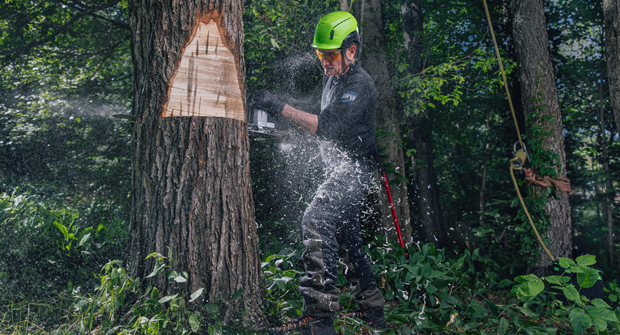
Transitioning from gas- to battery-powered equipment is a prime way for landscape and lawn care professionals to address noise pollution-related regulations, customer demand and corporate policies.
Commercial-grade, battery-powered landscape and lawn care equipment operates at lower decibel (dB) levels than their gasoline-powered counterparts. For example, professional gas mowers and blowers often operate at a noise level of 90–110 dB, comparable to riding a motorcycle in heavy traffic (around 95 dB). In contrast, Greenworks’ equipment is typically in the 60–85 dB range, with its blower operating at a whisper-quiet 65 dB.
On the surface, this decibel difference might not sound huge, but every 3 dB increase represents a doubling of sound intensity. This means an operator is exposed to far less sound energy over an eight-hour shift when operating battery-powered mowers and handheld tools. This fact reduces prolonged risks to hearing and operator fatigue.
Greenworks has spent the last decade engineering a best-in-class, battery-powered commercial equipment platform. This effort recently culminated in the release of the Optimus family of mowers and handheld tools, specifically designed to meet the demands of landscape and lawn care professionals.
According to Greenworks product experts, the reduced-noise advantages of the Optimus product line can be viewed through three distinct lenses.
Navigating regulations
Across the country, numerous jurisdictions have enacted noise bans, compelling landscape and lawn care pros to adopt battery-powered equipment to meet these regulations. And while some bans impose seasonal limitations, it remains an ever-evolving and intensifying issue for professional contractors, says Tony Marchese, senior vice president of sales and operations for the commercial business group at Greenworks.
Technological advancements have nullified previous contractor complaints that battery-powered equipment lacks the punch of gas-powered alternatives.
“And you saw this most with backpack blowers,” Marchese says. “But Greenworks and other manufacturers have brought more powerful battery-powered solutions into the marketplace. So, that conversation goes away because the technology addresses the productivity issue for contractors.”
Customer demands
In markets where noise ordinances are not yet in play, the pressure shifts to customer-centric requests to manage this nuisance.
Health facilities, hospitals, assisted living facilities and educational campuses all view noise as an impediment to their core activities. Quiet operation is often a nonnegotiable requirement for their landscape services provider.
Beyond client satisfaction, the reduced noise profile offers a major operational benefit. Electric equipment, like the Greenworks Optimus line of commercial solutions, is quiet enough to allow landscape crews to work earlier in the morning, as early as 6 or 7 a.m. in areas where noise ordinances typically restrict gas-powered operations until 8 a.m. or later.
“This enables a maintenance crew to get a jump start on their day,” says Per Kvarby, vice president of product management and marketing for the commercial business unit at Greenworks. “Or, if they choose, they can end their workday early, or switch to other activities when intense sun and heat are factors, resuming maintenance work later in the day. This flexibility creates more business opportunities and directly contributes to profitability.”
Securing high-value clients
Battery-powered equipment is a prime asset for securing high-value contracts, such as managing properties for homeowner associations and property management firms. According to Marchese and Kvarby, these entities increasingly identify noise and emissions as major factors in vendor selection, effectively ruling out landscape pros still reliant on gas-powered equipment.
“For these clients, the quiet operation afforded by the Optimus line is considered a tangible benefit,” Kvarby says. “And it can serve as a door opener for adding these types of properties to a landscape contractor’s client portfolio.”
To meet many of these growing noise-related demands from clients, Kvarby says it’s prudent for landscape professionals to reconsider their business model. To get started, he recommends transitioning one crew to battery-powered equipment to serve clients who demand quiet, emission-free operation.
“This serves as a door opener for contractors, giving them a competitive advantage and the ability to secure the business of more demanding clients,” he says.
Mike Zawacki is a Cleveland-based journalist and frequent contributor who has covered various aspects of the green, horticultural, sports turf, and irrigation industries for the last 20 years.