 SUBSCRIBE


For commercial landscaping professionals transitioning from gas to battery-powered equipment, establishing the correct infrastructure is critical. Poor planning negates the efficiency gains this technology provides, leading to financial waste, operational bottlenecks, and increased downtime.
With the Optimus platform for battery-powered mowers and handheld equipment, Greenworks introduced a product strategy built around customizable, modular support systems designed for commercial contractors.
“We don’t want landscapers to over-purchase. This is an ROI calculation,” says Nick Jiannas, Greenworks VP of sales and marketing. “We want contractors to invest in what they need to get their jobs done. We don’t want them to overinvest in energy they don’t need.”
The correct setup depends on a contractor’s specific operational demands and equipment configuration, says Per Kvarby, Greenworks’ VP of product management. For example, a maintenance crew running high-demand equipment, such as backpack blowers, requires a robust in-field charging solution to sustain productivity, whereas a crew focused on less-demanding tasks, such as edging and trimming, does not.
Optimized in the shop
According to Jiannas, a percentage of landscape and lawn care professionals lease their facilities, resulting in limited electrical capacity, typically a standard 15- or 20-amp circuit, and very little recourse for improvement. Plugging multiple chargers into these circuits overnight risks tripping breakers. The result is potentially devastating.
“It’s important to understand that when you start converting crews to [battery-powered equipment], you could have a lot of machines needing to be charged overnight. You can’t just plug them all into various shop outlets and assume it’s going to work,” Jiannas says. “I’ve heard horror stories where, overnight, the breaker pops and the crews come in the next morning and nothing’s charged.”
At the shop level, Greenworks provides contractors with intelligent charging solutions designed to manage available power.
The Charge Link system allows up to 60 handheld batteries to be charged from a single outlet, Jiannas says. It uses a switching mechanism across a daisy-chain of six-port caddies. The system monitors the charging status and input power, sequentially trickle-charging each caddy to ensure all batteries are fully charged overnight without overloading the circuit.
“The switching mechanism basically knows the charging status of the batteries in that caddy and how much energy is coming out of the wall,” Jiannas explains. “When the first caddy is filling up, it trickle charges it, and then moves to the next one, and the next one, and the next one. So, it does it in a manner that the contractor can get all 60 charged overnight.”
Greenworks’ Power Distribution Manager (PDM) is an intelligent, stackable system of four-port decks that supports all Greenworks’ products, including the OptimusZ zero-turn mower. According to Jiannas, this system measures the power coming from the contractor’s building and the battery status. If power demand exceeds a set threshold, the PDM intelligently regulates power by temporarily turning off one charging unit to protect the system and prevent a breaker from tripping.
“It recognizes if there’s more demand for power than the building’s got to give,” Jiannas explains. “So, it regulates it, and if it’s bumping up against the amp threshold, it’ll turn something off to protect the system so nothing breaks, nothing pops. It does that intelligently through all the products so the next morning, it’s all charged.”

Optimized in the field
Contractors converting entire crews to battery-powered equipment need a reliable mobile charging solution. This reduces the need to purchase and manage an excessive battery inventory, and it mitigates potential losses from theft or damage.
Greenworks offers commercial pros dedicated power systems for fully battery-powered crew trailers, such as the Optimist Crew Trailer. This enclosed mobile unit comes equipped with a charging array designed to power up to three OptimusZs and more than two dozen handheld batteries while parked or in transit.
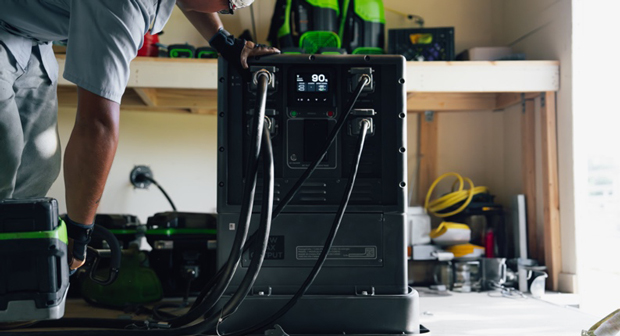
For contractors with existing trucks and trailers, Greenworks offers the Optimus Energy Cube as a mobile charging solution. Placed in the front of the trailer, this portable, high-capacity power station integrates all charging into a central unit. Jiannas says that by equipping the trailer with an external outlet, similar to an electric vehicle’s (EV) charger, an operator can plug in the entire trailer with a single cord at the shop. This eliminates the daily need for crews to remove and reinstall batteries and chargers, significantly improving efficiency.
Jiannas points to the 16-kilowatt (kW) Energy Cube, ideal for crews using OptimusZs, which yields two hours of mower run time for every hour of charging. A smaller 10 kW Energy Cube, by contrast, is engineered for crews utilizing primarily handheld equipment and walk-behind mowers.
For commercial pros who do not want to invest in the Energy Cube system but still require single-plug convenience, the stackable PDM system can be deployed on the trailer, Jiannas says. This enables intelligent, sequential management of the entire trailer’s charging system via one main plug, offering a modular, cost-effective alternative.
“We have a lot of customizable, modular-type charging systems,” Jiannas says. “So, if it’s a crew doing leaves or grass or it has one, two, or no zero-turns, we have a solution, and you can mix and match and get them what they need.”
Another important feature is Greenworks’ chargers utilize active cooling to rapidly lower battery temperature, which is necessary before recharging can begin. According to Kvarby, a common mistake is underestimating the time lost waiting for a hot, recently discharged battery to cool. Greenworks’ latest generation of batteries features an overall superior cell structure for commercial use and rarely requires a cool-down period. This allows crews to remove a battery directly from the tool, place it on the charger, and begin recharging immediately, maximizing tool runtime and job-site efficiency.
“People say it takes 45 minutes to charge a battery, but if it’s coming off a hot tool that’s been discharged a lot, heat builds up,” Kvarby explains. “The battery will need to come down to a certain temperature before you can start putting juice into it.
“Greenworks’ latest generation of batteries requires very little to almost no time to cool down,” he adds. “So, you can take those off right out of the tool, put them on the charger, and they’re already cool enough to start charging immediately.”

Mike Zawacki is a Cleveland-based journalist and frequent contributor who has covered various aspects of the green, horticultural, sports turf, and irrigation industries for the last 20 years.