 SUBSCRIBE


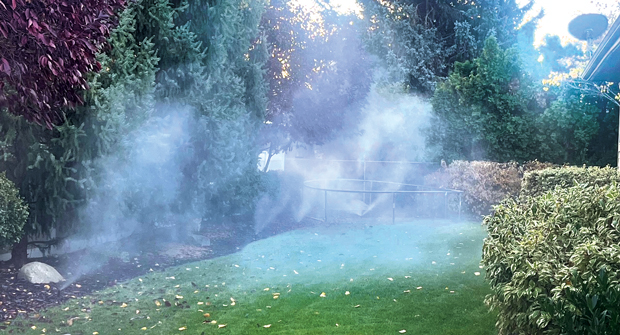
In cooler climates, a silent threat brews beneath the surface each fall — water trapped in irrigation lines, waiting to freeze, expand and wreak havoc.
That’s why it’s essential to winterize or blow out irrigation systems before the first freeze, so they’re not plagued with broken pipes and leaks.
“Leaving the systems charged over the winter when we drop below freezing temperatures can lead to catastrophic system damage that causes, at a minimum, significant repairs and, in a worst-case scenario, a complete replacement,” says Brian Peck, branch manager of Environmental Designs in Centennial, Colo.
Peck, Chris Rigby, territory manager for Rain Bird Corp., and Dave Mitchell, owner of Conserva Irrigation of Traverse Mountain, Utah, lay out their best advice for winterizing irrigation systems.
The process
The PVC pipe that’s typically used for irrigation systems is not forgiving when it comes to freeze-thaw cycles, says Rigby. Add that to the fact that many irrigation systems involve tiny dips where water can collect, and you’ve got a recipe for cracked or broken pipes.
Even worse, leaks caused by freeze damage often go unnoticed until the system is turned back on, by which time the repairs may be extensive and expensive.
That’s where irrigation winterizations come into play.
“If you’ve got water in the pipes,when it freezes, it will expand and break the pipe,” Rigby says. “If you allow the water to stay in the pipes, heads or valves, you’re talking very costly repairs. You may even have a leak that’s 20 feet long because the pipe shattered all the way through.”
The process of blowing out an irrigation system typically requires specialized equipment and should be done with care. It can take anywhere from 15 to 40 minutes depending on system size, zone count, pipe dimensions and the technician’s familiarity with the system. It involves turning off the water source and using an air compressor to force compressed air into the system, Mitchell says.
“You go zone by zone and run it until you’re down to the least amount of water that could possibly be pushed out of the irrigation heads,” Peck says.
Once that’s done, irrigation pros should turn off the controller for the season and then winterize the backflow device, Peck says.
When to winterize
The question of when to blow out an irrigation system depends on the region, but the experts agree that it should happen before the first freeze.
“Bursting pipes due to freezing temperatures can cause costly damage that can be avoided,” Mitchell says. “We recommend that our customers schedule their appointments ahead of time, typically in the early fall, to beat the freeze.”
Environmental Designs starts reaching out to customers to get winterizations on the schedule as early as August, with blowouts performed in October, Peck says.
While Peck concedes that years ago in his area, blowouts always began like clockwork on Oct. 1, many pros are waiting longer to start the processes.
“We see summers extending a little bit later now, so we’ve started the processes in the second or even the third week of October in order to get some additional moisture on the ground before we shut off,” Peck says. “The race is really to try and have systems completely winterized by Thanksgiving.”
To ensure they have all the necessary equipment, Mitchell suggests irrigation pros reserve the air compressor, if they don’t already have one, by June.
Top winterizing mistakes
While the process of winterizing irrigation systems is not extremely difficult or technical, irrigation pros should pay close attention to avoid these errors.
1. Not winterizing pump stations. Take the time to make sure pump stations are properly blown out, too, Rigby says.
“Don’t be quick and in a hurry to just get a bunch of winterizations done,” he says. “Make sure the filters are drained and winterized and that the pumps are taken care of as well. The pros that do a good job and continually have business are the ones that are extremely thorough.”
2. Neglecting to turn off the controller. Forgetting to shut off the controller can cause damage to the electrical side of the irrigation system, Peck says.
“Shutting off the controller makes sure a current is not run to the solenoids of the valves — that way, they don’t burn out,” he explains.
3. Failing to winterize backflow devices. It’s essential also to winterize the backflow device; otherwise, the system can sustain a lot of damage over the winter. Mitchell says pros should double-check that they’ve completed this task before leaving a property.
Rigby says he’s noticed some contractors physically removing the backflow device and taking it back to their shop, where they keep it for the winter.
“That’s kind of like an insurance policy that, a) the customer is going to pay and, b) that the irrigation pro will come back to do the spring startup,” Rigby says.
4. Cutting corners. Irrigation pros should be sure to complete each and every blowout process fully.
“If you’re not patient enough to get as much water as you can out of each irrigation zone as you’re working through it, you can end up ruining that zone, even if you do everything else right,” Peck says.
5. Incorrect psi. Pros should be careful with the air compressor settings. Using too much air pressure risks damage, while too little air pressure risks an incomplete blowout, Mitchell says. Experts suggest using a pressure of between 40 and 60 psi.
While Rigby says it’s tempting to crank the pressure up to 100 psi to get the winterization done faster, doing so can blow the system apart.
“That head can get so hot that when it retracts into the ground and everything cools off, it melts everything together,” Rigby says. “Then in the spring, when guys are trying to turn everything on, nothing pops up, and now they have to replace a bunch of sprinkler heads.”
All told, Peck says it’s important to explain to customers that even when properly blown out, some of the irrigation system’s plastic can get damaged, especially if the system is large.
“The plastics are rated to withstand the force of the air compressor, but the longer it takes, especially if it’s a larger system, it can get extremely hot on all those plastics,” Peck says.
Overall, however, Peck says it’s a bigger risk to not winterize than to winterize.
6. Missing fittings. Inadequate tools slow down the winterization process, according to Mitchell. He recommends creating a preseason checklist for a complete blowout kit with all necessary fittings.