 SUBSCRIBE


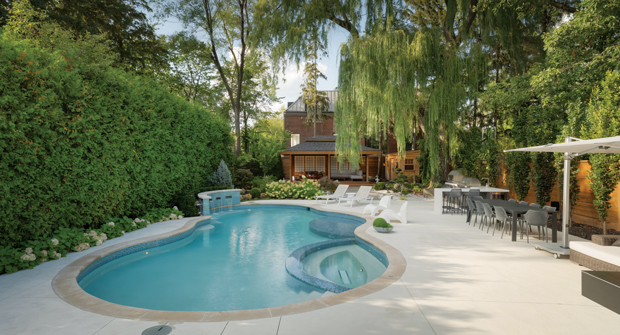
While some saw an overgrown nuisance, John Kenyon saw beauty.

Exceptional projects in landscape architecture often fuse inspiration and collaboration. As a sales manager and design consultant at Gib-San Pool and Landscape Creations in Toronto, Kenyon, a Master Certified Building Professional, proved this recently with a pool and backyard spa project that transformed an initial challenge into a stunning, cohesive design.
A Toronto backyard project began with the clients’ desire to remove a sprawling 100-year-old willow tree from their property. In its place, they envisioned an in-ground pool as the focal point of a more inviting backyard space. Their initial ideas, though, were a bit of a blank canvas for Kenyon, who was charged with creating a contemporary outdoor oasis.
The homeowners considered the willow tree a source of mess and maintenance. They were leaning toward having it removed, a decision Kenyon says could have created significant costs and fines due to local bylaws protecting the removal and destruction of mature trees.
Kenyon, though, saw an opportunity. He envisioned the willow as a natural sculpture that could anchor a design, and it was a concept quickly taking root in his mind’s eye. Why not make the tree’s immense presence the focal point, dictating a more organic, naturalistic approach to the overall project?
His first task was to save the willow, and he had to convince his clients that the tree was an asset, not an obstacle.
“As I started sketching out the backyard and showing them what could be done in the space, they started to realize that, yeah, it was kind of a magnificent tree to have there,” Kenyon says. “It focuses you. It makes you feel like you’re in a natural place.”
Inspired by the backyard’s natural feel and the tree’s proximity to the planned pool, Kenyon envisioned a free-form pool shape inspired by natural ponds, creating a harmonious blend of natural and man-made elements. The pool’s shape was an organic evolution. According to Kenyon, this was a bold move, as most designers opt for a more conventional rectangular shape.
“As I saw it, I kind of traced the edges of the property, and I noticed that it was already free form around the edges,” Keynon says. “It’s a totally original design; there’s nothing else like it.”
Contemporary, clean materials intentionally complemented the free-form pool. Kenyon’s design choices reflected modern elements, with acid-etched architectural concrete and glass pool tiles creating visual dynamics for the space.
The project’s momentum and the client’s growing trust in Kenyon’s vision led to incorporating a custom fire pit cut out of the pool’s concrete deck, which followed the pool’s fluid lines.
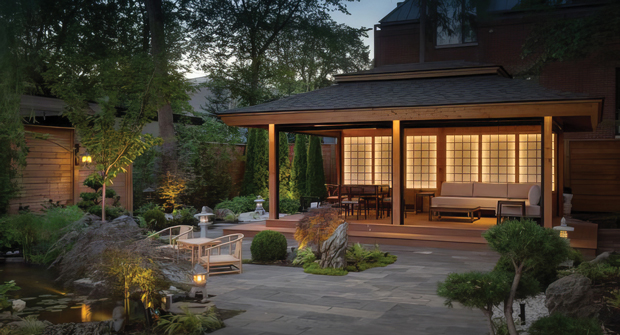
Additional design elements included a koi pond and a striking cabana. The koi pond was a deliberate extension of the swimming pool’s holistic free-form design with a natural waterfall and strategically placed stonework that Kenyon says contributes to the space’s natural feel.
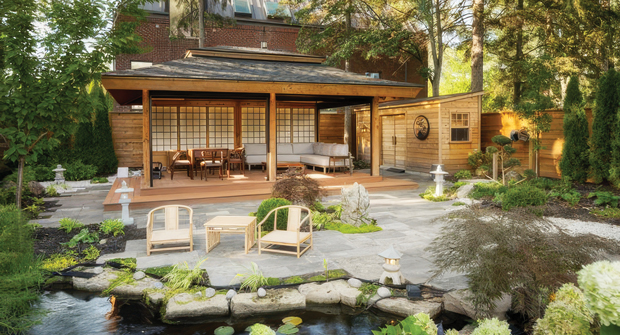
The cabana presented a unique opportunity to incorporate the client’s cultural background into the backyard space. Kenyon hand-sketched a modern design with frosted glass panels that mimicked the look of rice paper and paid tribute to his clients’ Asian heritage. Skylights contributed natural daytime illumination. The final structure, made of all-natural cedar, harmonizes with the rest of the backyard landscape.
The project’s success, which Kenyon attributes to communication and collaboration throughout the project, is a testament to the give-and-take between designer and client. For example, client requests lead to some adjustments in the project, such as widening the pool to accommodate lap swimming. Still, the core design reflected the designer’s initial vision.
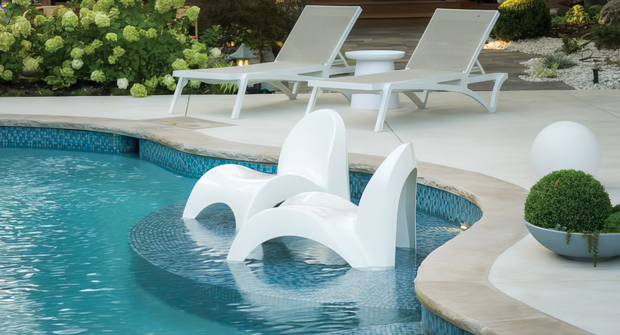
The final design is both beautiful and highly functional, according to Kenyon. Two years later, the property remains in pristine condition.
“Sometimes the best designs don’t come from a blank slate, but from working with the unique challenges and opportunities that a site presents,” Kenyon says. “We took a messy, century-old willow and worked closely with the clients to embrace it to create a more compelling and meaningful space.”